
VALLE D'AOSTA
Alpine archaeology yields 5,300-year-old yeast; scientists brew sourdough from Iceman's remains
Discovery in Oetzi's frozen gut revives questions about prehistory on the roof of Italy
Camille Bréan1,542 wordsEdition №7Sunday, 7 June 2026 — Edition № 7
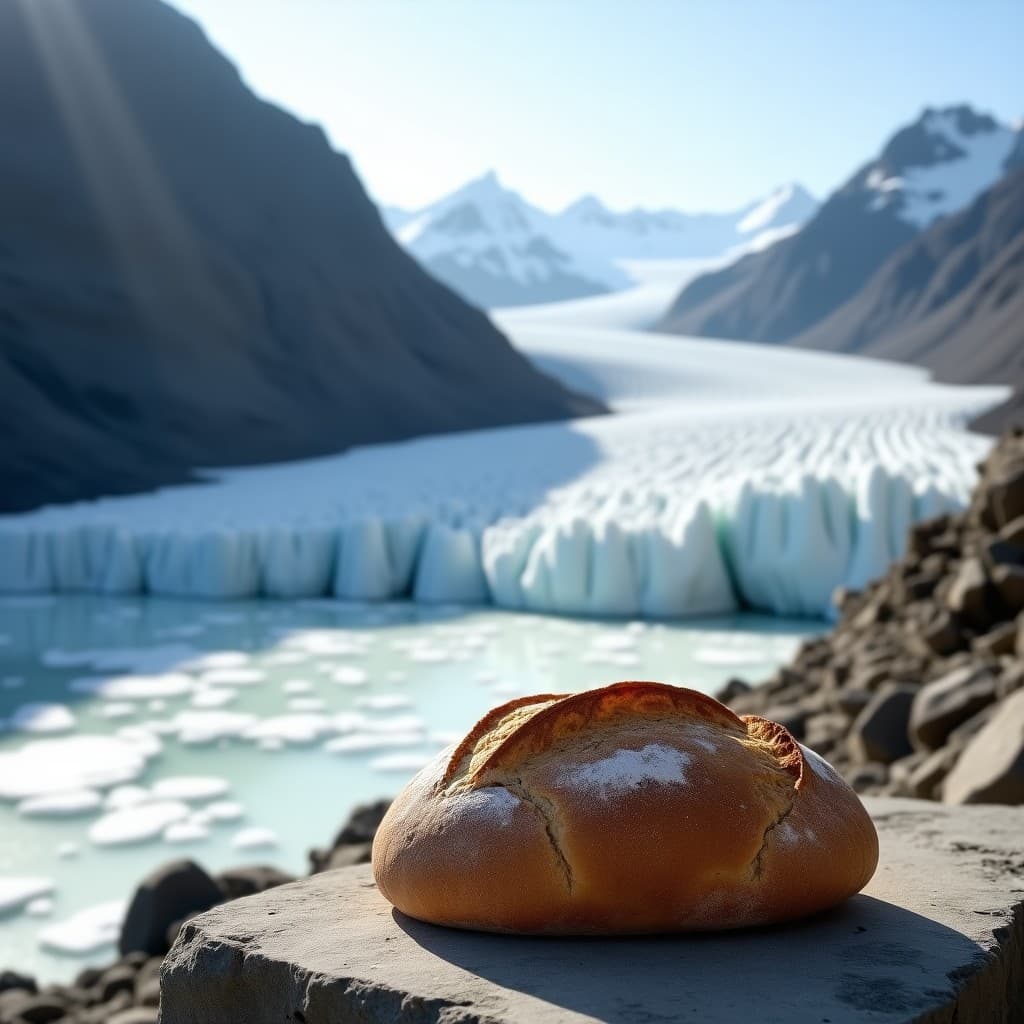
Researchers have isolated living yeast from the gastrointestinal tract of Oetzi the Iceman, the naturally mummified human remains discovered in the Alps on the Austria-Italy border, CBS News reported this week. The yeast, which has remained viable in the frozen body for more than 5,300 years, was used by scientists to produce a functioning sourdough starter and bake bread. The discovery, confirmed by researchers speaking to AFP, offers an unprecedented window into the microbial life of prehistoric Alpine communities.
Oetzi was discovered in 1991 on the Similaun glacier, near the border between South Tyrol and Austria, at an elevation of roughly 3,200 metres. The body had been preserved by the Alpine cold and ice for millennia, its tissues, organs, and gut contents intact. The yeast discovery represents one of the oldest living microorganisms ever recovered from human remains, and the first time such ancient microbes have been successfully cultured and used to produce food.
The implications for Alpine archaeology are substantial. Oetzi's gut contents have long been studied to understand prehistoric diet and trade patterns. The presence of viable yeast suggests that fermentation—and thus bread-making, beer production, and other fermented foods—may have been part of Alpine life in the Copper Age, thousands of years before such practices were documented in Mediterranean or European lowland societies. This challenges conventional narratives about where and when fermentation technologies emerged.
The Iceman's discovery in 1991 transformed Alpine archaeology. The body, dated to around 3300 BCE, was found with clothing, tools, and weapons that provided unprecedented detail about Copper Age life in the high mountains. Oetzi had been shot with an arrow, likely in conflict, and had died on the glacier. The extreme cold and aridity of the high Alpine environment had mummified him naturally, preserving soft tissues that normally decompose within years.
CBS News's report on the yeast discovery emphasises the scientific method: researchers isolated the microorganism, cultured it in laboratory conditions, and used it to ferment flour and water into a functional sourdough starter. This is not speculation or inference; it is direct evidence of a living organism from the Copper Age. The yeast species, once identified, can be compared to modern strains to understand how microbial populations have evolved or remained stable over five millennia.
For Valle d'Aosta, the Iceman discovery holds particular resonance. The region sits on the same Alpine chain where Oetzi was found, separated by roughly 100 kilometres and a political border. The valley's own archaeological record includes evidence of prehistoric settlement, trade, and Alpine adaptation. The yeast discovery suggests that the technological and culinary practices of prehistoric Alpine peoples were more sophisticated than previously understood. Fermentation, as a technology, requires knowledge of microbial processes—knowledge that Oetzi's community apparently possessed.
The implications extend to the region's contemporary food culture. Valle d'Aosta is known for its dairy products, cured meats, and traditional breads. Some of these foods rely on fermentation: cheese production, in particular, depends on microbial cultures. The discovery that fermentation was practised in the Alpine region five thousand years ago creates a narrative continuity: modern Alpine food traditions may have roots deeper than previously documented. This is not merely historical curiosity; it is a claim about cultural identity and continuity.
The yeast was found in Oetzi's gut, meaning it was part of his microbiome at the time of his death. This raises questions about the source of the yeast. Did Oetzi consume fermented bread or beer? Was the yeast part of his natural gut flora, or did he ingest it through food? CBS News's report does not specify, but the discovery itself confirms that the yeast was present in his body and remained viable through millennia of freezing. This suggests that the Alpine environment—the extreme cold and aridity—acted as a perfect preservative not just for human tissue but for microbial life.
The scientific process of culturing the yeast and producing bread is significant. Researchers did not merely identify the yeast; they demonstrated that it could function in a modern fermentation process. This is a form of experimental archaeology: using ancient biological material to recreate prehistoric food production. The resulting bread, made from ancient yeast, becomes both a scientific artifact and a symbolic object. It connects modern consumers to a five-thousand-year-old Alpine past.
The discovery also has implications for understanding Alpine trade networks. Oetzi's body contained evidence of long-distance trade: copper from the Alps, flint from distant sources, and other materials that suggest contact with lowland communities. If fermentation was practised in the Alpine region, the yeast itself may have been traded or shared between communities. Yeast cultures, once established, can be propagated and transported. The presence of viable yeast in Oetzi's gut might indicate that fermentation knowledge and microbial cultures were part of Alpine exchange networks.
CBS News's framing of the story emphasises the scientific achievement: extracting and culturing ancient microorganisms. But the story also carries cultural weight. The Iceman has become an icon of Alpine identity, particularly in South Tyrol, where the mummified remains are housed in a museum in Bolzano. The yeast discovery adds another layer to this identity: the Iceman becomes not just a symbol of Alpine resilience and adaptation but also of Alpine culinary sophistication. He becomes a figure through which modern Alpine communities can claim continuity with prehistoric ancestors.
The timing of the discovery is worth noting. It comes at a moment when Alpine regions are increasingly focused on cultural tourism and the valorisation of traditional food practices. Valle d'Aosta, like other Alpine regions, markets its food heritage as a draw for visitors. The yeast discovery provides scientific validation for claims about the antiquity and authenticity of Alpine food traditions. It transforms folklore into archaeology, and marketing into historical fact.
The preservation of the yeast also raises questions about other microorganisms in Oetzi's remains. His gut contained not just yeast but bacteria and other microbes. If yeast survived five thousand years of freezing, other microorganisms may have as well. This opens possibilities for understanding prehistoric disease, diet, and microbial ecology. The Iceman's body becomes a time capsule not just of human culture but of the microbial world that surrounded and inhabited prehistoric Alpine peoples.
For contemporary Alpine communities, the yeast discovery offers a form of cultural validation. The region's food traditions—bread-making, fermentation, dairy production—are not merely modern practices but continuations of ancient knowledge. This narrative is powerful for regional identity and tourism marketing. It suggests that when visitors consume Valle d'Aosta's traditional foods, they are participating in practices that stretch back five thousand years. The yeast discovery provides scientific evidence for this claim.
The research also highlights the role of the Alpine environment in preservation. The extreme cold and aridity of high-altitude zones create conditions that can preserve organic material for millennia. This has made the Alps a unique archaeological resource. Oetzi is not the only prehistoric human found in the Alps; others have been discovered, and many more may remain frozen in glaciers. As climate change causes Alpine glaciers to retreat, more prehistoric remains are being exposed. The yeast discovery suggests that these newly exposed remains may contain viable biological material, offering new opportunities for understanding prehistoric Alpine life.
The scientific community's response to the yeast discovery is likely to be significant. The ability to culture and use ancient microorganisms opens new avenues for experimental archaeology and microbial history. Other researchers may attempt similar extractions from other prehistoric remains. The Iceman's yeast becomes a proof of concept: ancient microorganisms can survive and be revived. This has implications not just for archaeology but for understanding the deep history of human-microbial relationships.
For Valle d'Aosta specifically, the discovery reinforces the region's position as part of a larger Alpine archaeological and cultural zone. The Iceman was found on the border between Italy and Austria, in territory that is now South Tyrol. But the Alpine chain extends through Valle d'Aosta, and the region's own prehistoric record is intimately connected to the broader Alpine story. The yeast discovery is a reminder that the region's cultural heritage is not merely Italian or French but Alpine—a shared inheritance of mountain communities across national borders.
The bread baked from Oetzi's yeast becomes a symbol of this Alpine continuity. It is not merely a scientific curiosity but a tangible connection to the prehistoric past. If the bread were to be tasted—and CBS News does not specify whether it was—it would represent a direct sensory link across five thousand years. The flavour, texture, and aroma would be shaped by yeast that last functioned in a Copper Age human body. This is archaeology made edible, history made tangible.