
VENETO
Russia's Return to Venice Biennale Sparks Activist Confrontation
Pussy Riot and FEMEN protest Moscow's pavilion as art world grapples with Ukraine war politics
Tommaso Veronese1,389 wordsEdition №9Tuesday, 9 June 2026 — Edition № 9
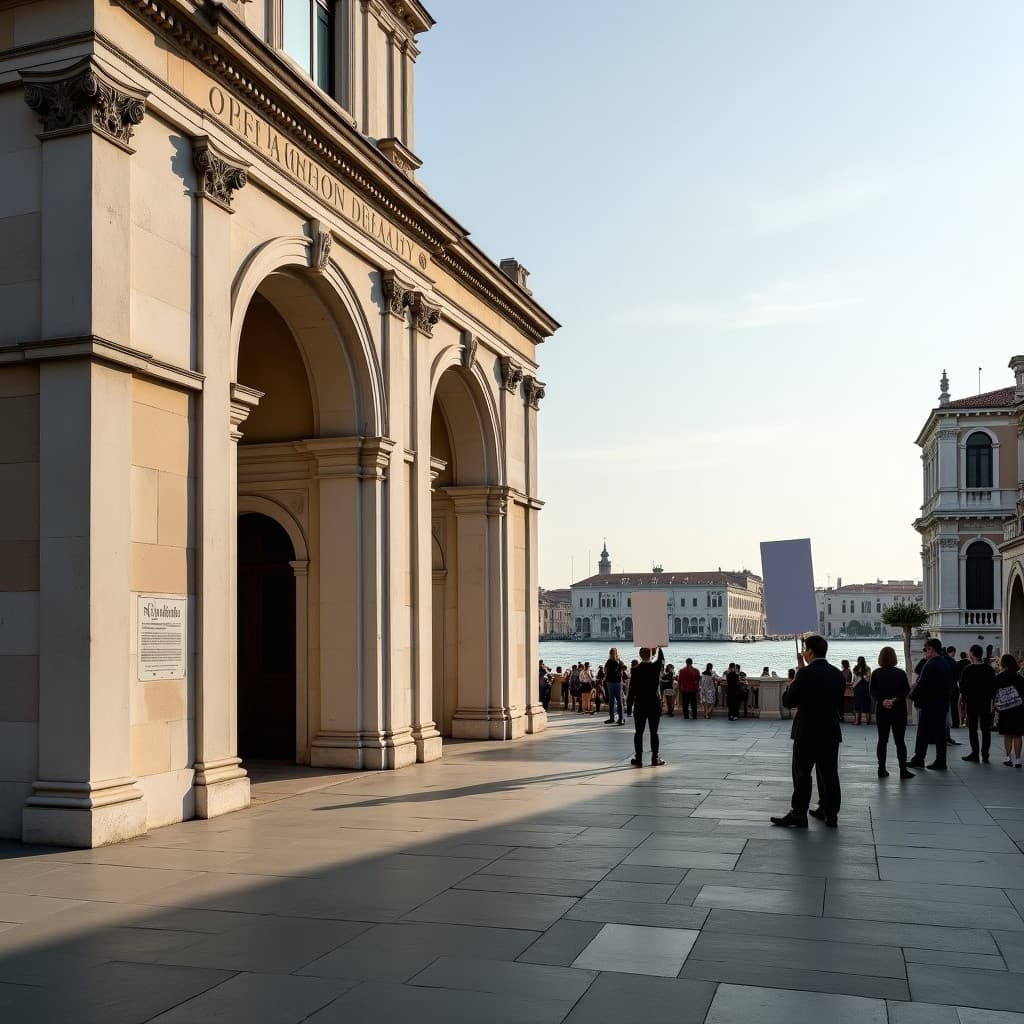
The Venice Biennale, long a stage for art and politics intertwined, has erupted into direct confrontation over Russia's participation. According to Newser, Pussy Riot and FEMEN activists protested at the Russian pavilion after Moscow's return to the exhibition following its absence in the years after the 2022 invasion of Ukraine. The protest marks a sharp collision between the Biennale's stated commitment to artistic freedom and the geopolitical reality of a war that continues to divide Europe.
The Biennale's decision to readmit Russia has proven contentious. The exhibition, which opened in Venice in spring 2026, positions itself as a global forum for contemporary art. Yet the presence of a Russian pavilion—after years of exclusion—has drawn immediate scrutiny from activists who view Russia's participation as a form of cultural legitimacy for a state engaged in an ongoing conflict. The protest at the pavilion itself, captured by international media, underscores the tension between artistic inclusion and political accountability.
For Venice and the Veneto, the Biennale's role as a cultural institution and economic engine is inseparable from its global prestige. The exhibition draws collectors, critics, curators, and tourists from across the world; it shapes Venice's image as a center of contemporary art and attracts spending that supports the city's economy. When the Biennale becomes a site of political protest, it complicates that narrative and raises questions about how the city manages its role as a neutral cultural space.
The Biennale has a long history of navigating political controversy. Founded in 1895, it has weathered fascism, Cold War tensions, and debates over representation and inclusion. The decision to exclude Russia after 2022 was itself controversial—some argued it violated artistic principles of openness; others saw it as a necessary response to military aggression. Russia's readmission in 2026 suggests a shift toward normalization, but the activist response indicates that consensus has not been reached.
Pussy Riot, the Russian feminist punk collective, has a particular history with political protest in art spaces. The group's members have faced imprisonment and exile for their activism; their appearance at the Biennale to protest Russia's pavilion carries symbolic weight. FEMEN, a Ukrainian-led feminist activist group, has similarly used public spaces to make political statements. Their joint protest at Venice signals that the war's cultural dimensions remain contested and unresolved.
The foreign press has treated the Biennale's geopolitical dimensions with increasing attention. International art critics and journalists have noted that major exhibitions can no longer claim to exist outside politics. The Biennale's readmission of Russia forces the institution to confront questions about whether artistic freedom requires political neutrality, or whether neutrality itself is a political choice.
For Venice's cultural institutions, the protest raises practical questions. The Biennale is managed by a foundation that includes Italian state representation; decisions about participation involve diplomacy as well as curatorial judgment. The presence of activists at the Russian pavilion—and the international media coverage that follows—affects how the city is perceived globally. Venice's image as a serene cultural destination is complicated by scenes of political confrontation.
The Veneto region has long positioned itself as a center of artistic production and heritage tourism. The Biennale is the flagship institution, but the region also hosts the Peggy Guggenheim Collection, numerous smaller galleries, and a thriving contemporary art scene. When the Biennale becomes a site of political protest, it shapes how international audiences perceive Venetian culture more broadly. The protest is not merely about Russia; it is about what role art institutions should play in responding to geopolitical conflict.
The timing of Russia's return is significant. The war in Ukraine continues; peace negotiations remain stalled; Russian forces maintain territorial gains. The Biennale's decision to readmit Russia in this context can be read as either pragmatic (art transcends politics) or complicit (normalization without accountability). The activist protest rejects the pragmatic reading and asserts that some political questions cannot be bracketed in the name of artistic freedom.
International coverage of the protest has been limited but pointed. Newser's reporting captures the confrontation without extensive analysis, but the fact that major news outlets are covering activist action at the Biennale signals that the story has resonance beyond Venice's art world. For the city's tourism economy, such coverage is double-edged: it draws attention to the Biennale, but it also frames Venice as a site of political tension rather than aesthetic escape.
The question of how Venice's institutions will respond to future protests remains open. The city has experience managing large crowds and competing interests; the Biennale has protocols for security and access. But the presence of activists at the Russian pavilion suggests that the institution's authority to define acceptable speech and protest is itself contested. The Biennale cannot simply exclude activists without raising questions about censorship; nor can it ignore protests without appearing indifferent to the war.
For the Veneto region's international reputation, the Biennale's handling of geopolitical questions matters. The region markets itself as a center of culture, craft, and heritage; it relies on international visitors and collectors. When the Biennale becomes a flashpoint for Cold War tensions, it complicates that marketing. Yet it also reflects a deeper reality: Venice and the Veneto are not isolated from global politics. The war in Ukraine, the return of great-power competition, the question of how cultural institutions should respond to conflict—these are not abstract issues for Venice. They shape how the city is perceived and how its institutions navigate their role in a divided world.
The protest at the Russian pavilion is unlikely to be the last confrontation at this Biennale. As the exhibition continues through November, other political questions—representation, decolonization, climate—may generate similar activism. Venice's role as a global cultural stage means that it will continue to be a site where art and politics collide. The city's ability to manage these collisions while maintaining its reputation as a center of artistic excellence will be tested in the months ahead.