
VENETO
Geopolitics intrudes on Venice's art show as Russia returns to contested ground
Activists protest Moscow's pavilion at the 2026 Biennale, reopening questions about art, politics and the Cold War's unfinished business.
Tommaso Veronese1,358 wordsEdition №5Friday, 5 June 2026 — Edition № 5
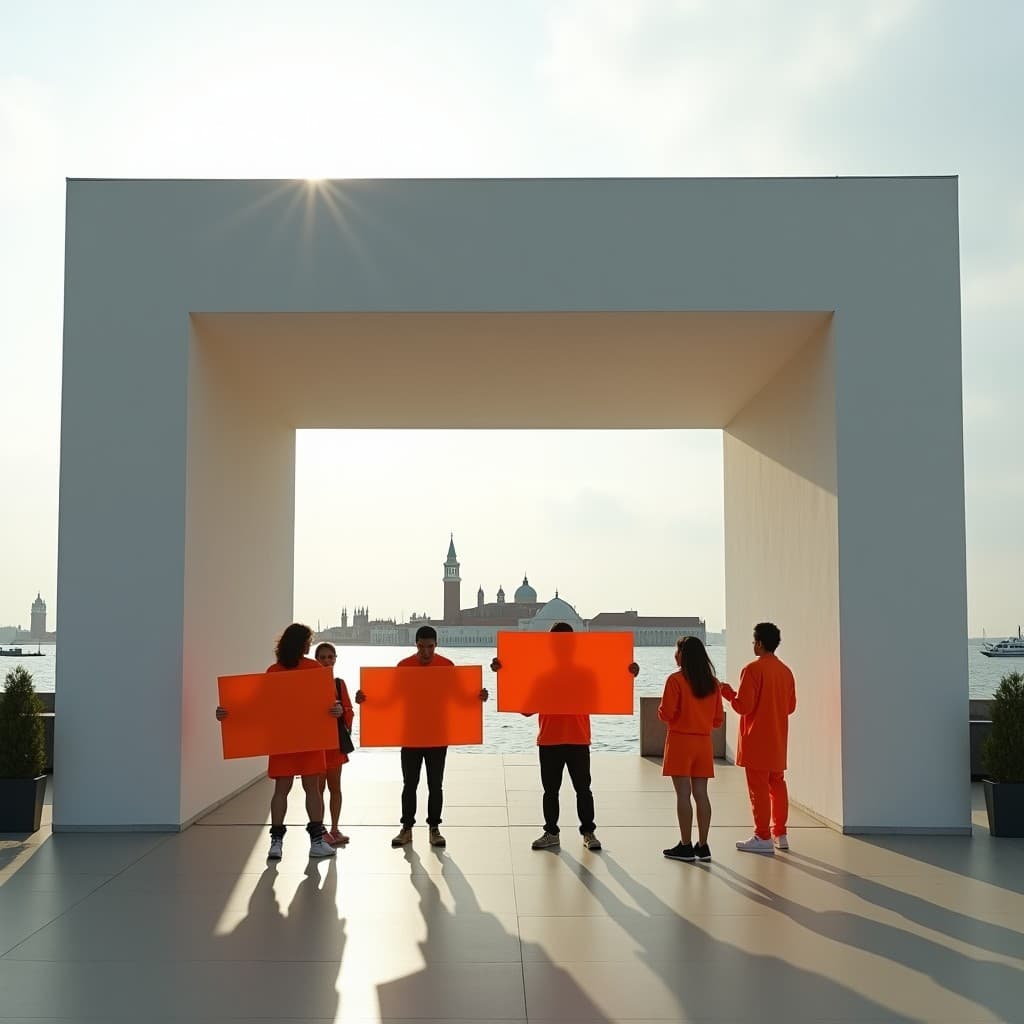
The 2026 Venice Biennale, one of the world's most prestigious art exhibitions, has become a flashpoint for geopolitical tensions. According to Newser, activists including members of Pussy Riot and FEMEN have protested Russia's presence at the festival, demonstrating in front of the Russian pavilion. The protest marks Russia's return to the Biennale after its absence following the 2022 invasion of Ukraine—a gap that raised questions about whether the festival could or should exclude nations on political grounds.
The Biennale, which takes place in Venice every two years, is one of the world's oldest and most influential contemporary art exhibitions. It has long positioned itself as a space where nations present their artistic achievements to a global audience. Yet the festival has never been purely aesthetic; it has always been entangled with politics, diplomacy, and national prestige. Russia's pavilion, like those of other major powers, serves as a vehicle for soft power and cultural influence.
For Venice and the Veneto, the Biennale is both a cultural institution and an economic engine. The festival draws international collectors, critics, curators, and tourists to the city, generating revenue for hotels, restaurants, and galleries. It also shapes Venice's global image as a centre of artistic innovation and cosmopolitan culture. When the Biennale becomes a site of political conflict, it complicates that image.
The question of Russia's participation in the Biennale reflects a broader tension in the international art world: can art be separated from politics, or is such separation a fiction that serves the powerful? According to Newser's reporting, the presence of Pussy Riot and FEMEN activists at the Russian pavilion signals that for some, the answer is clear—art cannot be divorced from the geopolitical moment in which it is made and displayed.
Pussy Riot, the Russian feminist punk rock group, has been a vocal critic of the Kremlin since its formation in 2011. The group's members have faced arrest, imprisonment, and exile for their activism. FEMEN, a Ukrainian feminist activist group, has similarly used provocative public actions to challenge authoritarian power. Their joint protest at the Biennale represents a direct challenge to Russia's attempt to rehabilitate its international image through cultural participation.
The 2022 invasion of Ukraine created a rupture in the international art world. Many Western institutions, including museums and festivals, suspended their relationships with Russian cultural organisations and artists. The Venice Biennale, in response, did not invite Russia to participate in the 2022 edition. This decision was itself controversial—some argued that excluding a nation punished individual artists for their government's actions, while others contended that art institutions have a responsibility to take moral stances on geopolitical violence.
By 2026, the question of Russia's return had become unavoidable. The war in Ukraine continues, but the initial shock and unity of Western response have fragmented. Some nations have resumed diplomatic and cultural ties with Russia; others have maintained strict sanctions and exclusions. The Biennale's decision to allow Russia to participate again reflects this fragmentation, but it also invites the kind of protest that Pussy Riot and FEMEN have staged.
For Venice, the protest raises practical and symbolic questions. The city is already dealing with the consequences of mass tourism, which has transformed it into a theme park of itself. The Biennale, while prestigious, is also a major draw for tourists and media attention. When the festival becomes a site of political protest, it generates additional media coverage and attracts visitors who come not for art but for activism. This can amplify both the festival's cultural significance and its role in Venice's transformation into a spectacle.
The Veneto's relationship to Russia is complex. The region has significant trade ties with Russia, particularly in the luxury goods and wine sectors. Sanctions imposed after the 2022 invasion have disrupted these relationships, affecting small manufacturers and exporters across the region. Yet the Veneto is also part of the European Union and NATO, aligned with Western positions on Ukraine. The Biennale protest thus touches on economic interests that are felt in factories and vineyards across the region.
Historically, the Venice Biennale has been a site where Cold War tensions played out in aesthetic form. During the 1950s and 1960s, the festival became a venue for competing visions of modernity—American abstract expressionism versus Soviet socialist realism. The festival's architecture and layout reflected these divisions, with national pavilions arranged in ways that encoded geopolitical hierarchies. The presence of Russia in 2026, and the protest against it, suggests that the Cold War's aesthetic and political legacies remain unresolved.
The international art press has covered the Biennale protest with interest, but also with some ambivalence. Critics and curators have noted that political protest at art festivals can overshadow the art itself, reducing complex aesthetic questions to simple political statements. Yet others argue that art that ignores geopolitical reality is complicit in that reality, and that festivals like the Biennale have a responsibility to acknowledge the political dimensions of their own existence.
The protest also raises questions about who gets to speak at the Biennale and whose voices are heard. Pussy Riot and FEMEN are using the festival as a platform for their activism, turning the Russian pavilion into a site of counter-speech. This mirrors the Biennale's own stated mission—to be a space where diverse voices and perspectives are represented. Yet it also exposes the tension between the festival's role as a showcase for national prestige and its role as a space for critical artistic practice.
For Venice's cultural institutions, the Biennale protest is a reminder that the city's role as a centre of art and culture is inseparable from its role in global geopolitics. Venice has long been a site where East and West have met, traded, and competed. The Biennale continues that tradition, but in a contemporary register where the stakes are not trade routes but soft power, cultural influence, and the legitimacy of nations in the international order.
The 2026 Biennale will likely continue to be marked by protest and controversy. The question of Russia's participation, and the broader question of how art institutions should respond to geopolitical conflict, will not be resolved by a single festival. Yet Venice's role as the host city means that the Biennale's struggles are also Venice's struggles—struggles to maintain its identity as a space of artistic freedom and cosmopolitan exchange while acknowledging the political realities that shape that space.
Looking forward, the Biennale faces a choice: it can attempt to depoliticise itself by excluding political protest and focusing narrowly on aesthetic questions, or it can acknowledge that art and politics are inseparable and create space for both artistic expression and political critique. The presence of Pussy Riot and FEMEN at the Russian pavilion suggests that the festival's visitors and critics will not allow it to retreat into pure aestheticism. The Biennale, like Venice itself, is a site where the world's conflicts and contradictions inevitably appear.