
NATIONAL
Bolzano courthouse collapses; no deaths reported in Alpine city
Structural failure at regional judicial seat raises questions about building safety across Italy's aging infrastructure
Klara Hofer487 wordsEdition №50Sunday, 19 July 2026 — Edition № 50
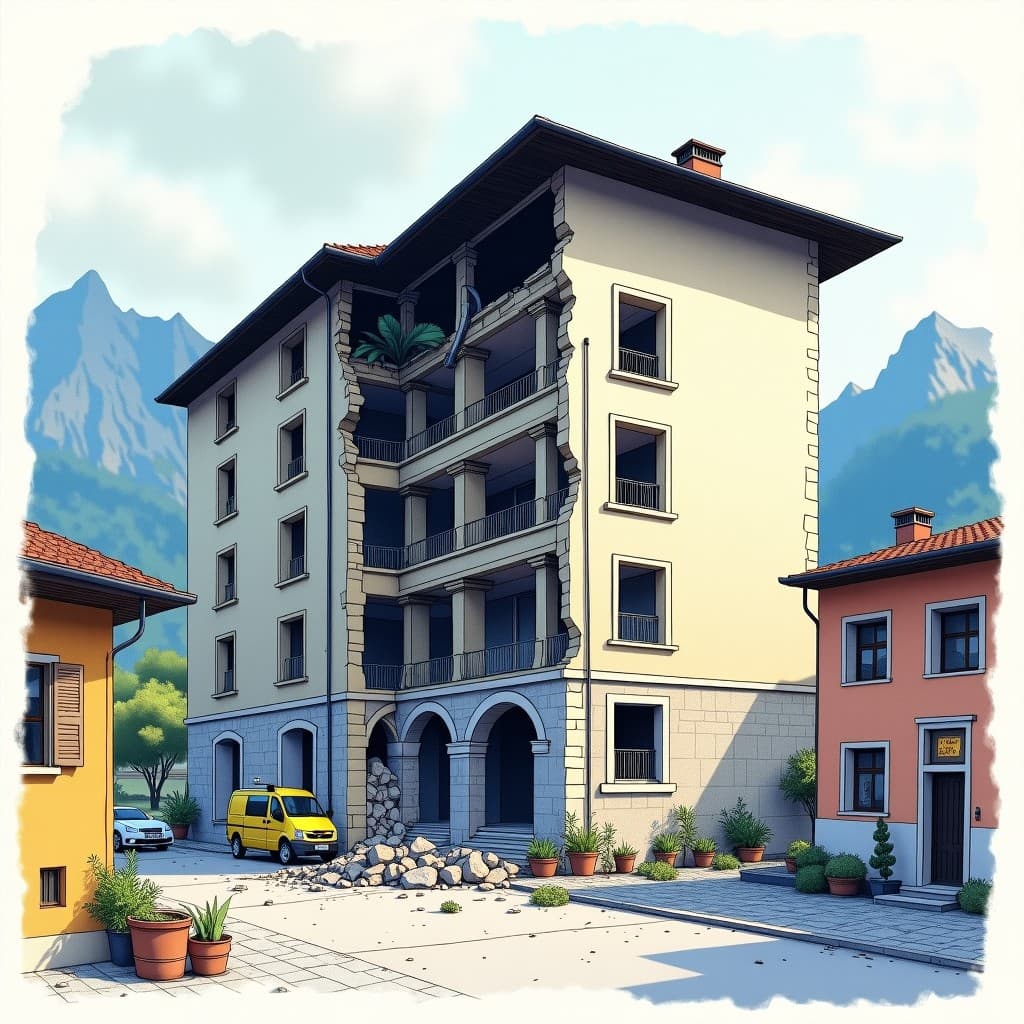
A section of the Bolzano courthouse collapsed on Friday, according to reports from The Local Italy. The incident occurred at the judicial seat of the Trentino-Alto Adige region's German-speaking province, which serves as the venue for regional and provincial courts. No deaths were recorded, and the immediate cause of the structural failure remained under investigation.
The collapse comes as Italy confronts a broader infrastructure crisis. On Thursday, an Italian court sentenced 32 defendants, including the former chief executive of motorway operator Autostrade, over the 2018 collapse of the Morandi Bridge in Genoa, which killed 43 people. France 24 reported that the verdict underscored systemic failures in maintenance and oversight across Italy's aging infrastructure, a pattern that extends beyond highways to public buildings.
For Trentino-Alto Adige, a region with substantial autonomy over its own infrastructure and services, the incident raises questions about building inspection protocols and maintenance standards. The South Tyrol region, which manages much of its own budget and administration under Italy's special autonomy statute, will likely face scrutiny over whether local oversight of public structures has kept pace with the region's aging building stock. The Brenner region sits at the intersection of Alpine geology and heavy use, factors that compound structural stress on facilities.
The Bolzano courthouse serves as the administrative and judicial heart of South Tyrol's provincial government. The facility handles cases across civil, criminal and administrative law for the German-speaking minority, a population of roughly 330,000 within the region's 1.078 million inhabitants. The collapse of such a central civic building, even without loss of life, signals a potential gap in the region's infrastructure management.
The timing compounds the concern. The Genoa verdict this week exposed what The Guardian called "a pattern of negligence and cost-cutting" in Italy's approach to public infrastructure. Castellucci and other Autostrade executives were convicted of failing to maintain the Morandi Bridge despite knowing of structural defects. The court found that cost-cutting and deferred maintenance led directly to the deaths of 43 people in August 2018. That same logic—deferred maintenance, budget constraints, aging materials—applies to public buildings across all regions, including Trentino-Alto Adige.
South Tyrol's special autonomy, enshrined in the 1972 Second Autonomy Statute, grants the province substantial control over its own budget, schools, healthcare and infrastructure. This independence is a point of civic pride in the bilingual region, which has maintained its distinct German-speaking identity and Austro-Hungarian administrative traditions within the Italian state. However, autonomy also means the province bears direct responsibility for the condition of its own public assets. The courthouse collapse will test whether that responsibility has been adequately discharged.