
VALLE D'AOSTA
Austrian blockade of Brenner Pass deepens Alpine transit crisis
Protesters shut vital motorway as traffic strain on the corridor reaches breaking point
Camille Bréan1,356 wordsEdition №6Saturday, 6 June 2026 — Edition № 6
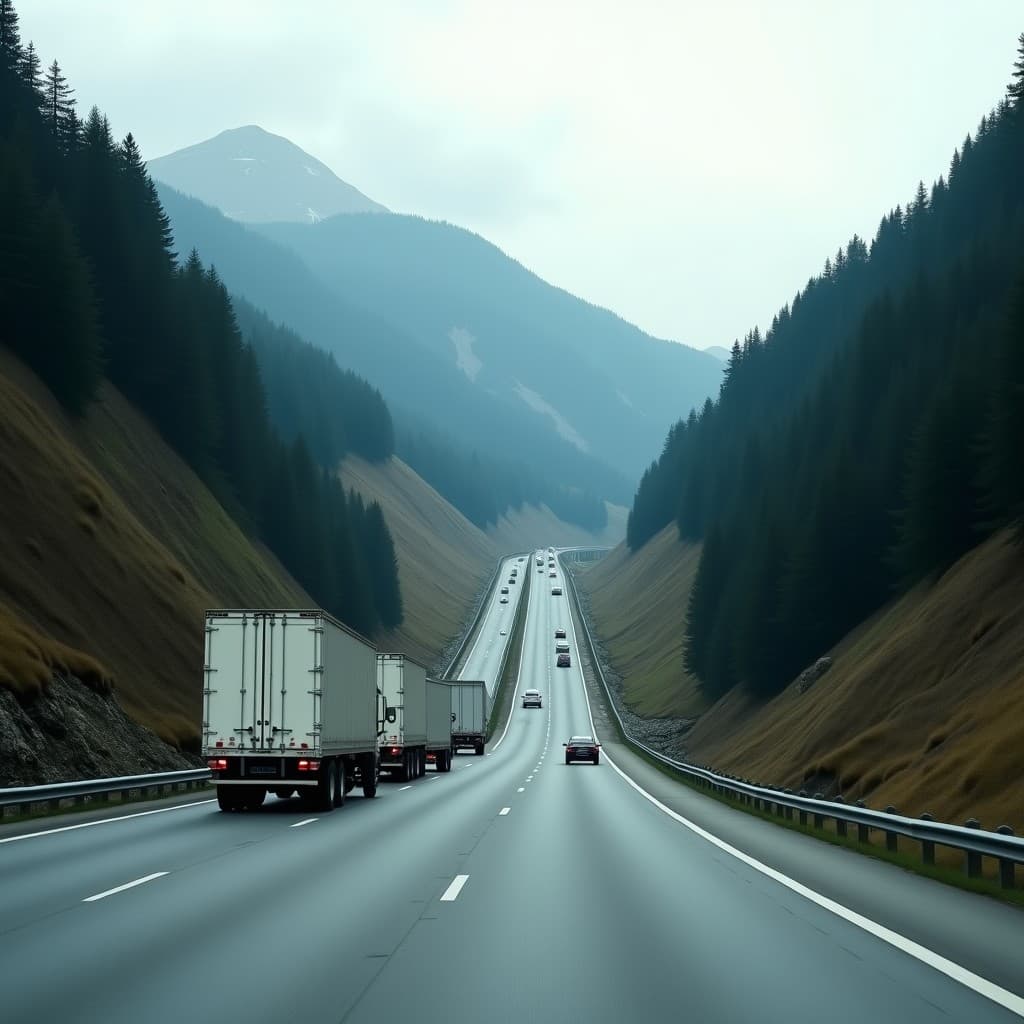
Protesters in Austria have shut the Brenner motorway, the primary transit route between Germany and Italy across the Alps, according to Reuters reporting from late May. The blockade reflects escalating tensions over traffic volume on a corridor that has become a critical artery for European commerce and tourism. The closure, which occurred near Matrei in the Austrian Tirol, represents a direct challenge to the logistics networks that depend on uninterrupted Alpine passage.
The Brenner Pass has served as a mountain crossing for centuries, but its modern incarnation as a high-speed motorway has transformed it into one of Europe's busiest transit corridors. Tens of thousands of vehicles traverse the route daily, carrying goods between northern Europe and the Mediterranean, as well as tourists heading to Alpine resorts and southern destinations. The Austrian protests signal that communities along the route have reached a limit to the traffic they will tolerate.
For the Valle d'Aosta, which lies south of the Brenner Pass and depends on cross-border traffic for both tourism and trade, the blockade carries immediate economic consequences. The region's position as a gateway between Italy and France means that disruptions to the Brenner corridor can redirect traffic toward alternative Alpine routes, including the Mont Blanc tunnel and the Great St. Bernard Pass. Such diversions strain the Valle d'Aosta's own infrastructure and alter the distribution of environmental impact across the mountain chain.
The Brenner motorway, formally the A13 in Austria and the A22 in Italy, has been in continuous operation since the 1970s. It represents one of the European Union's core transport corridors, designated as part of the trans-European transport network that connects the Baltic to the Mediterranean. The route carries approximately 2,000 trucks daily under normal conditions, a figure that swells during summer tourism season and around major European holidays.
Austrian communities along the corridor have long complained about air pollution, noise, and road safety risks associated with heavy traffic. Environmental organizations have documented elevated levels of particulate matter and nitrogen oxides in valleys adjacent to the motorway. The protests that closed the route in late May were organized by local residents and environmental groups demanding that the Austrian and Italian governments impose stricter limits on transit traffic.
The blockade, which Reuters reported occurred on May 30, 2026, represents an escalation from previous demonstrations. Earlier protests had slowed traffic but not achieved a complete closure. The decision to shut the motorway entirely signals a shift in protest strategy and reflects growing frustration with what demonstrators view as inadequate government response to traffic-related environmental and quality-of-life concerns.
The Austrian government's response to the blockade has been cautious. Officials have acknowledged the legitimate grievances of communities affected by transit traffic but have emphasized the economic importance of the Brenner corridor to both Austria and Italy. The European Union has also expressed concern about disruptions to a critical transport link, though EU institutions have limited direct authority over national motorway management.
For Italy, the blockade poses a particular challenge. The Brenner Pass is the primary route through which goods from northern Europe reach Italian ports and markets. Disruptions to the corridor create bottlenecks that ripple through supply chains across the country. Italian logistics companies and manufacturers have expressed concern about the potential for repeated blockades if the underlying traffic issues are not resolved.
The Valle d'Aosta's position in this dynamic is complex. The region benefits from transit traffic through its own territory, particularly via the Mont Blanc tunnel, which provides an alternative route for traffic seeking to avoid the Brenner corridor. However, the region also suffers from the environmental consequences of heavy traffic on its own mountain passes. The Brenner blockade may increase traffic through Valle d'Aosta routes, exacerbating local environmental pressures.
The Mont Blanc tunnel, which connects the Valle d'Aosta to the French Haute-Savoie, has been the subject of its own traffic disputes. France and Italy have disagreed over the terms of access and the distribution of environmental costs associated with the tunnel's use. The Brenner blockade may intensify pressure on the Mont Blanc route, potentially reigniting Franco-Italian negotiations over tunnel management and traffic regulation.
The Great St. Bernard Pass, which also connects the Valle d'Aosta to Switzerland, represents a third alternative for traffic seeking to bypass the Brenner corridor. However, this route is less suitable for heavy trucks due to its elevation and road characteristics. The blockade of the Brenner thus creates pressure on the two other major Alpine crossings that serve the region.
The environmental impact of redirected traffic is a central concern for Alpine communities. The Brenner corridor, despite its traffic volume, is a modern motorway designed to minimize environmental impact through noise barriers, emission controls, and careful routing. Alternative routes may lack such infrastructure, potentially increasing the environmental burden on communities that host them. The Valle d'Aosta's own transit routes would bear additional strain if Brenner traffic is diverted.
The Austrian protests also reflect broader European debates about climate change and transportation. The EU has committed to reducing greenhouse gas emissions from transport, yet the growth of freight traffic across the continent continues to increase. The Brenner blockade can be understood as a local manifestation of a continental problem: the tension between economic growth, which depends on mobility, and environmental sustainability, which requires constraints on mobility.
Tourism represents another dimension of the traffic crisis. The Brenner corridor serves not only commercial trucks but also private vehicles carrying tourists to Alpine resorts. The summer season brings a surge in traffic as visitors from across Europe travel to ski resorts, hiking destinations, and cultural sites. The Valle d'Aosta, which depends heavily on tourism revenue, has an interest in maintaining smooth traffic flow, but also in reducing the environmental damage that tourism traffic causes.
The blockade raises questions about the governance of Alpine transit. The Brenner Pass lies on the border between Austria and Italy, and the motorway is jointly managed by the two countries. However, Austrian communities have limited formal mechanisms to influence Italian traffic policies, and vice versa. The EU provides a framework for coordination, but enforcement of traffic regulations remains primarily a national responsibility.
Several European transport and environmental publications have noted that the Brenner blockade reflects a failure of political will to implement effective traffic management policies. Proposed solutions include congestion pricing, which would charge vehicles for using the corridor during peak hours; modal shift policies, which would encourage freight to move by rail rather than road; and time-of-day restrictions on heavy vehicles. None of these measures has been fully implemented, despite years of discussion.
The Valle d'Aosta's regional government has expressed concern about the blockade and its potential consequences for cross-border trade and tourism. The region's economy depends on smooth connections to both France and Switzerland, as well as to the rest of Italy. Disruptions to the Brenner corridor threaten to isolate the region economically and may force traffic onto routes that the region considers inadequately equipped to handle increased volume.
Looking forward, the Brenner blockade appears likely to intensify pressure on both the Austrian and Italian governments to negotiate a comprehensive traffic management agreement. Such an agreement would need to balance the economic interests of both countries with the environmental and quality-of-life concerns of Alpine communities. The Valle d'Aosta, as a region that hosts alternative transit routes, will likely play a role in any such negotiations, advocating for policies that distribute traffic more equitably across the Alpine chain.