
VENETO
Pink visitors: flamingos return to Venice's recovering wetlands
Growing population signals ecological shift in the lagoon as habitat restoration takes hold
Tommaso Veronese1,247 wordsEdition №3Wednesday, 3 June 2026 — Edition № 3
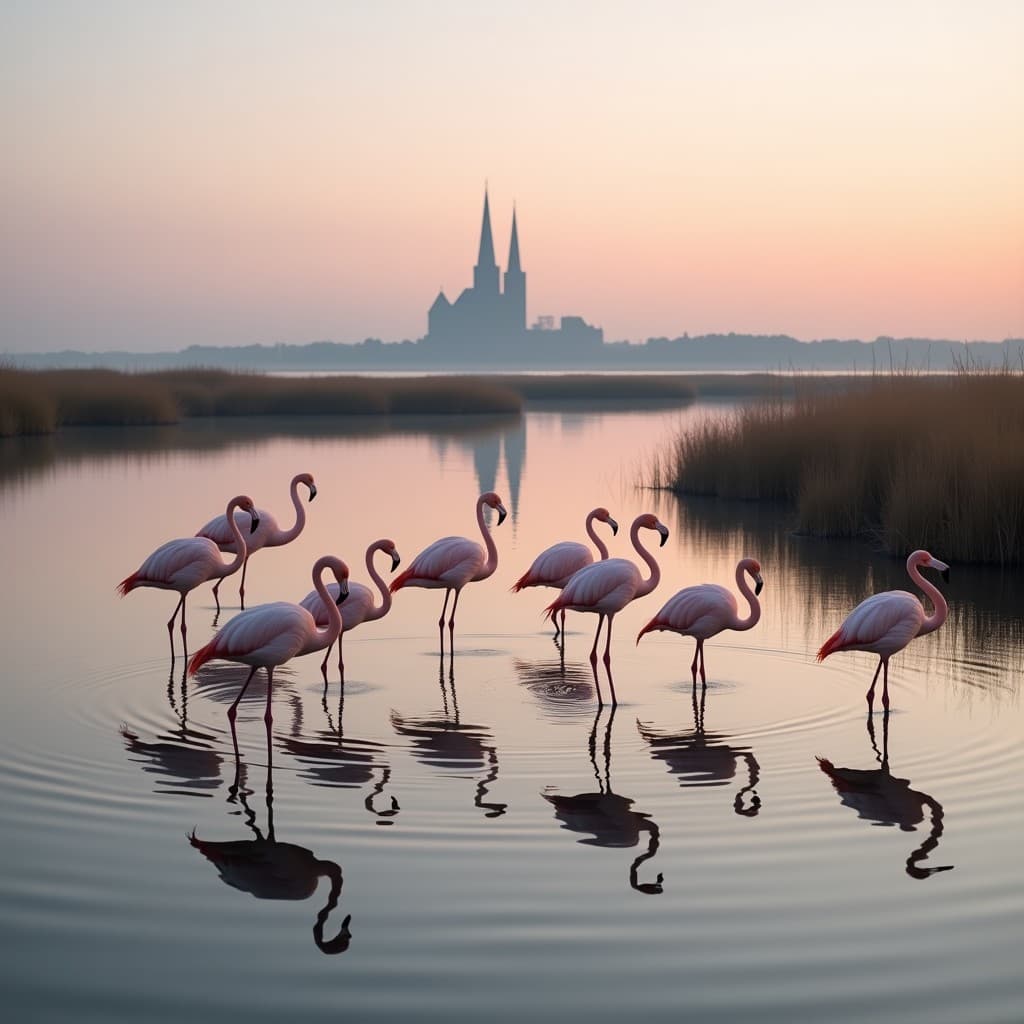
The Venetian lagoon is hosting an unexpected visitor. According to AP News, flamingos have begun to establish a growing population in the lagoon's recovering wetlands, a phenomenon that marks a significant ecological shift in one of Europe's most fragile and closely watched water systems. The birds, which had largely vanished from the region, are now feeding and nesting in restored habitat areas, their presence documented by observers in late May.
The return reflects years of wetland restoration work in and around the lagoon, part of broader efforts to stabilize an ecosystem under siege from subsidence, sea-level rise, and the weight of mass tourism. The flamingos' arrival signals that the lagoon's capacity to support wildlife is improving, even as the broader question of Venice's habitability—for both humans and the natural world—remains contested in international discourse.
For the Veneto region, the flamingo population carries symbolic and practical weight. The birds are visible proof that the lagoon can recover when given space and protection, a message that resonates in foreign coverage of Venice's environmental crisis. Yet their presence also underscores a paradox: as the lagoon becomes more ecologically robust, it continues to sink, and the city above it continues to empty of residents.
The flamingos observed in the lagoon this spring represent a return after decades of absence. The species had been driven from the region by habitat loss, pollution, and the general degradation of shallow-water ecosystems across the Mediterranean. Their reappearance in the Venetian lagoon, documented by AP News in May, suggests that restoration initiatives—including the creation of protected shallow-water zones and the reduction of certain industrial pressures—are beginning to create conditions hospitable to species that had abandoned the region.
The lagoon's ecology has long been a focal point of international scientific and environmental attention. UNESCO, which designated Venice and its lagoon as a World Heritage Site in 1987, has repeatedly warned of the site's vulnerability to climate change, subsidence, and anthropogenic stress. The return of flamingos, while modest in scale, represents a measurable reversal of one aspect of that decline: the lagoon's capacity to support migratory and resident bird populations.
Restoration work in the lagoon has accelerated over the past decade, driven partly by the urgency of the MOSE flood barrier project and partly by recognition that the lagoon cannot be saved as a static monument. Instead, it must function as a living ecosystem. This means allowing natural processes—including the return of species like flamingos—to resume. The birds feed on small fish, crustaceans, and algae in shallow waters, and their presence indicates that these food chains are re-establishing themselves.
Yet the flamingos' return occurs against a backdrop of persistent environmental stress. The lagoon continues to subside at a rate of several millimeters per year, a process accelerated by groundwater extraction in the twentieth century and now compounded by sea-level rise driven by climate change. The MOSE barrier, which began regular operation in 2020, has successfully prevented the worst acqua alta (high water) events, but it does not address subsidence or the long-term viability of the lagoon as an ecosystem.
For Venice's human population, the ecological recovery is a mixed signal. The city has lost roughly half its residents since the 1950s, a decline that has accelerated in recent years as younger people leave for the mainland and tourism reshapes the urban fabric. The return of flamingos to the lagoon is celebrated in international environmental coverage, yet it occurs in a city where human habitation is becoming increasingly precarious. The birds are thriving in restored wetlands while the city's own future remains uncertain.
The flamingo population also intersects with Venice's tourism economy in ways that foreign observers have begun to note. The birds are visible from vaporetto routes and from the lagoon's edges, and they represent a form of natural spectacle that complements the city's cultural and architectural attractions. Yet they also embody a tension: as Venice becomes more of an open-air museum—a destination for day-trippers and cruise passengers—the lagoon itself is being restored as a functioning ecosystem rather than a backdrop for human activity.
International environmental organizations have highlighted the flamingo return as evidence that large-scale habitat restoration can work, even in heavily human-dominated landscapes. The birds' presence suggests that the lagoon's shallow-water zones, when protected from fishing pressure and given time to recover, can support the biodiversity that characterized the region before industrial development. This message resonates in European environmental policy debates, where Venice's lagoon is often cited as both a cautionary tale and a potential model for ecosystem recovery.
The flamingos' diet and behavior also provide data on water quality and food-chain health. Their presence in significant numbers indicates that the lagoon supports adequate populations of the small organisms they feed on, a sign that nutrient cycling and primary productivity are recovering. This information feeds into the broader scientific monitoring of the lagoon, which involves researchers from Italian universities, UNESCO, and international environmental agencies.
From a regional economic perspective, the flamingo population adds to Veneto's natural heritage narrative. The region markets itself internationally not only through Venice's art and architecture but also through its natural landscapes—the Dolomites, the Prosecco hills, the lagoon itself. The return of flamingos to the lagoon can be framed as part of a broader story of environmental stewardship and ecological recovery, a narrative that appeals to international visitors increasingly concerned with sustainability.
However, the flamingos' success must be contextualized within the larger crisis of Venice's depopulation and the lagoon's physical instability. Foreign correspondents covering the city have noted that ecological recovery and human habitability are not automatically aligned. A lagoon that is ecologically healthier may still be a lagoon that is rising relative to the city built upon it, making human residence increasingly difficult. The flamingos thrive in the same waters that threaten the foundations of the buildings above.
The restoration efforts that have enabled the flamingos' return are themselves the product of decades of international pressure and scientific consensus about the lagoon's value. The Ramsar Convention on Wetlands, which designates the Venetian lagoon as a site of international importance, has provided a framework for protection and restoration. The flamingos' presence is thus not simply a natural recovery but the result of coordinated policy, funding, and scientific management at multiple scales.
Looking forward, the flamingo population will likely continue to grow if habitat protection and restoration efforts persist. International observers will continue to monitor the birds as an indicator of lagoon health, and their presence will feature in environmental coverage of Venice and the Veneto region. Yet their success also raises uncomfortable questions about what the lagoon is for—a functioning ecosystem, a heritage site, a tourist attraction, or some combination of these—and who benefits from its recovery.