
VENETO
Pink arrivals signal Venetian wetland recovery
Record flamingo numbers find refuge as ecological restoration reshapes the lagoon ecosystem
Tommaso Veronese1,247 wordsEdition №6Saturday, 6 June 2026 — Edition № 6
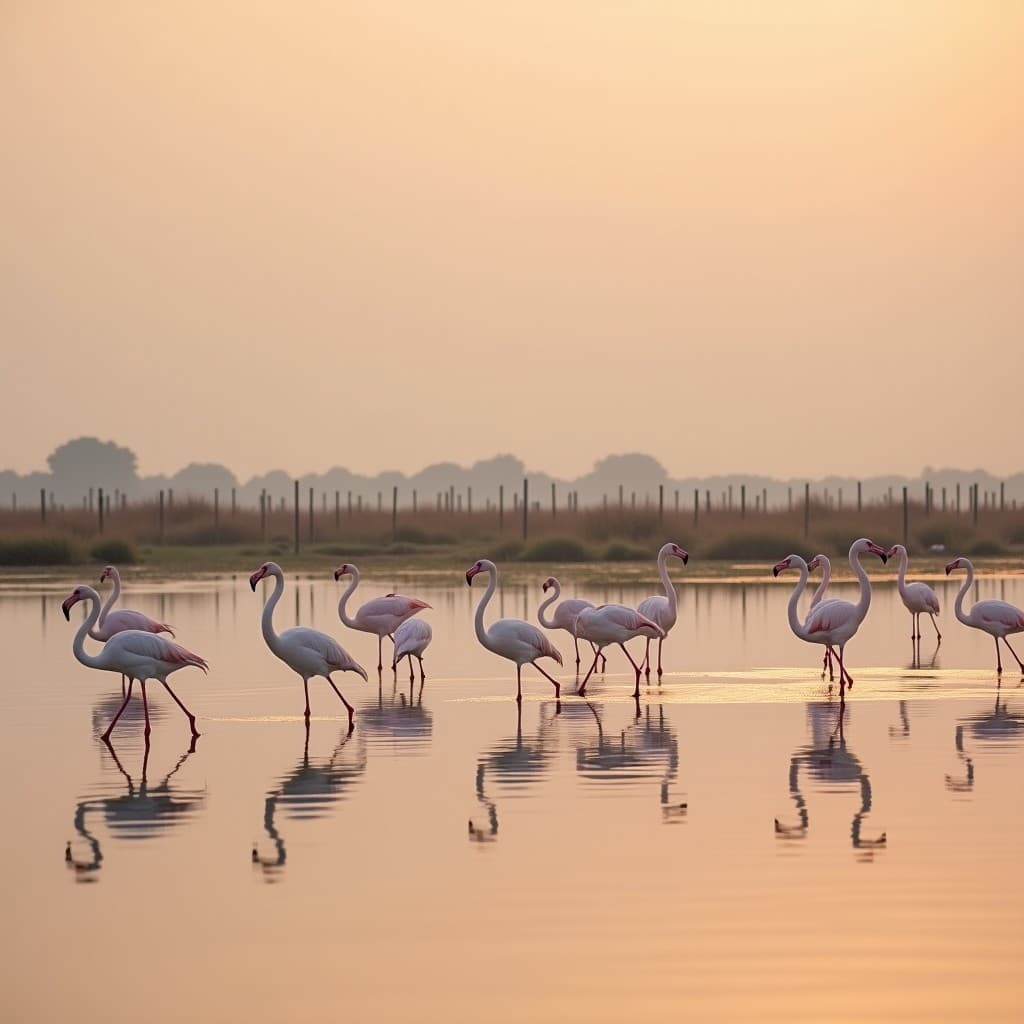
The pale pink birds have become an unlikely symbol of ecological recovery in the Venetian lagoon. According to the Associated Press, flamingos are now arriving in record numbers, drawn by restoration efforts that have expanded their habitat across damaged wetlands. The local Venetian dialect, which has words for nearly every creature that inhabits the lagoon, has no established term for them—a linguistic gap that underscores how recently these birds have become residents rather than occasional visitors.
The flamingos' presence reflects a broader shift in the lagoon's biological character. Ecological projects designed to restore salt marshes and shallow waters have inadvertently created conditions that attract species once absent from the region. As the AP reported, restoration work could help expand their habitat further and possibly induce them to nest in the lagoon permanently, a development that would represent a fundamental change in the ecosystem's composition.
For Venice, the arrival of flamingos carries a double significance. The birds offer a visible measure of environmental recovery at a moment when the city confronts multiple ecological pressures—subsidence, rising sea levels, and the strain of mass tourism. Yet their presence also complicates the lagoon's already delicate equilibrium, introducing a new variable into a system that has been shaped by human intervention for centuries.
The Venetian lagoon has long been a laboratory of human-engineered ecology. Since the medieval period, Venetian authorities have managed water flows, redirected rivers, and manipulated salt marshes to preserve the city's maritime advantage and protect it from silting. That legacy of intervention continues today, though with different aims: restoration rather than exploitation, ecological recovery rather than strategic advantage.
The modern restoration movement gained momentum in the 1990s and 2000s, as international scientific bodies and UNESCO—which designated Venice and its lagoon a World Heritage site in 1987—pressed for measures to reverse decades of industrial damage. Wetland reconstruction projects, funded partly by the Italian government and the European Union, have worked to recreate the shallow-water habitats that once dominated the lagoon before urban expansion and industrial development drained and filled them.
Flamingos are not native to the Venetian lagoon in any historical sense. The species is associated with Mediterranean and North African salt marshes, and their appearance in Venice is a consequence of both climate change and habitat restoration. Warmer winters have allowed birds from southern populations to survive further north, while the expansion of suitable wetland habitat has provided the food and shelter they require. The AP noted that this convergence of factors has produced a phenomenon that local observers are still processing.
The ecological implications remain uncertain. Flamingos are filter feeders, consuming small crustaceans and algae from shallow waters. Their presence could alter nutrient cycling in the lagoon and affect the abundance of other species that depend on the same food sources. Local fishermen, who work the lagoon's traditional clam beds and fish stocks, have watched the arrival with mixed feelings—a new species represents both a sign of environmental health and a potential competitor for resources in an already stressed ecosystem.
For Venice's tourism industry, flamingos have become an unexpected asset. The birds are visually striking and photograph well, adding to the lagoon's appeal as a destination for nature-focused visitors. Travel writers and environmental journalists have seized on the flamingo story as evidence that Venice's ecological future is not entirely bleak. This narrative—of recovery amid decline—resonates with international audiences concerned about the city's survival.
Yet the flamingo narrative also obscures harder truths about the lagoon's condition. Restoration projects, while genuine, remain limited in scope and funding compared to the scale of environmental challenges facing Venice. The MOSE flood barrier, designed to protect the city from acqua alta and rising seas, has been operational only since 2020 and remains controversial among scientists who question its long-term efficacy. Subsidence continues, driven by groundwater extraction and the weight of the city itself. Climate projections suggest that even aggressive emissions reductions will not prevent significant sea-level rise in the Adriatic over the coming decades.
The flamingos' arrival also reflects a broader pattern of species redistribution across the Mediterranean. As climate zones shift northward, southern species are colonising new territories, while northern species retreat. This process, documented extensively in the international scientific press, is reshaping ecosystems across Europe. Venice's lagoon, with its unique combination of restoration investment and climate exposure, is becoming a visible case study in how human management and natural change interact.
Local environmental groups in the Veneto have cautiously welcomed the flamingos while pressing for expanded restoration funding. According to international coverage, there is growing recognition that the lagoon's recovery cannot rely on isolated projects; it requires integrated management across the entire watershed, including the rivers that feed the lagoon and the agricultural lands upstream. The flamingos, in this view, are a sign that the direction is correct, but that much more work remains.
The birds also raise questions about what recovery means for Venice. Is the goal to restore the lagoon to some historical baseline—and if so, which historical moment? Or is it to create a resilient ecosystem adapted to contemporary and future conditions, even if that means accepting species compositions that would have been unthinkable a generation ago? The flamingos embody this ambiguity: they are a success story of restoration, yet they also represent a transformed lagoon, one that is becoming something other than what it was.
For the Veneto region more broadly, the flamingo story fits into a larger narrative about environmental change and economic adaptation. The region's economy depends heavily on tourism, agriculture, and small-scale manufacturing. Environmental degradation threatens all three. The flamingos offer a small counterweight to narratives of inevitable decline, suggesting that with sustained effort, some ecological damage can be reversed. Yet they also serve as a reminder of how fragile that recovery is, and how dependent it remains on continued investment and political will.
International environmental journalists have begun to track the flamingo population as a bellwether of lagoon health. The AP's coverage, which reached audiences across North America and beyond, frames the birds as an indicator species—a visible measure of whether restoration efforts are working. This framing has given the flamingos outsized symbolic importance, transforming them from a biological curiosity into a marker of Venice's ecological future.
The question of whether flamingos will establish a breeding population in the lagoon remains open. The AP reported that restoration efforts could induce them to nest, but nesting would require not only suitable habitat but also freedom from disturbance during breeding season. Venice's tourism industry, which brings millions of visitors to the lagoon each year, poses an obvious challenge. The tension between conservation and tourism access—a recurring theme in international coverage of Venice—will likely shape the flamingos' fate.
Looking forward, the flamingos' presence will almost certainly become a fixture of Venice's environmental identity. Travel guides will mention them; birdwatchers will add the lagoon to their itineraries; environmental reports will cite their numbers as evidence of recovery. Yet their symbolic importance should not obscure the harder work of managing the lagoon's future: controlling pollution, managing water levels, adapting to climate change, and balancing human use with ecological integrity. The flamingos are a sign of hope, but hope alone will not save Venice.