
VENETO
Pink arrivals: flamingos colonise the recovering Venetian lagoon
Record numbers of the birds are nesting in restored wetlands, marking an ecological shift in Europe's most fragile lagoon system.
Tommaso Veronese1,247 wordsEdition №5Friday, 5 June 2026 — Edition № 5
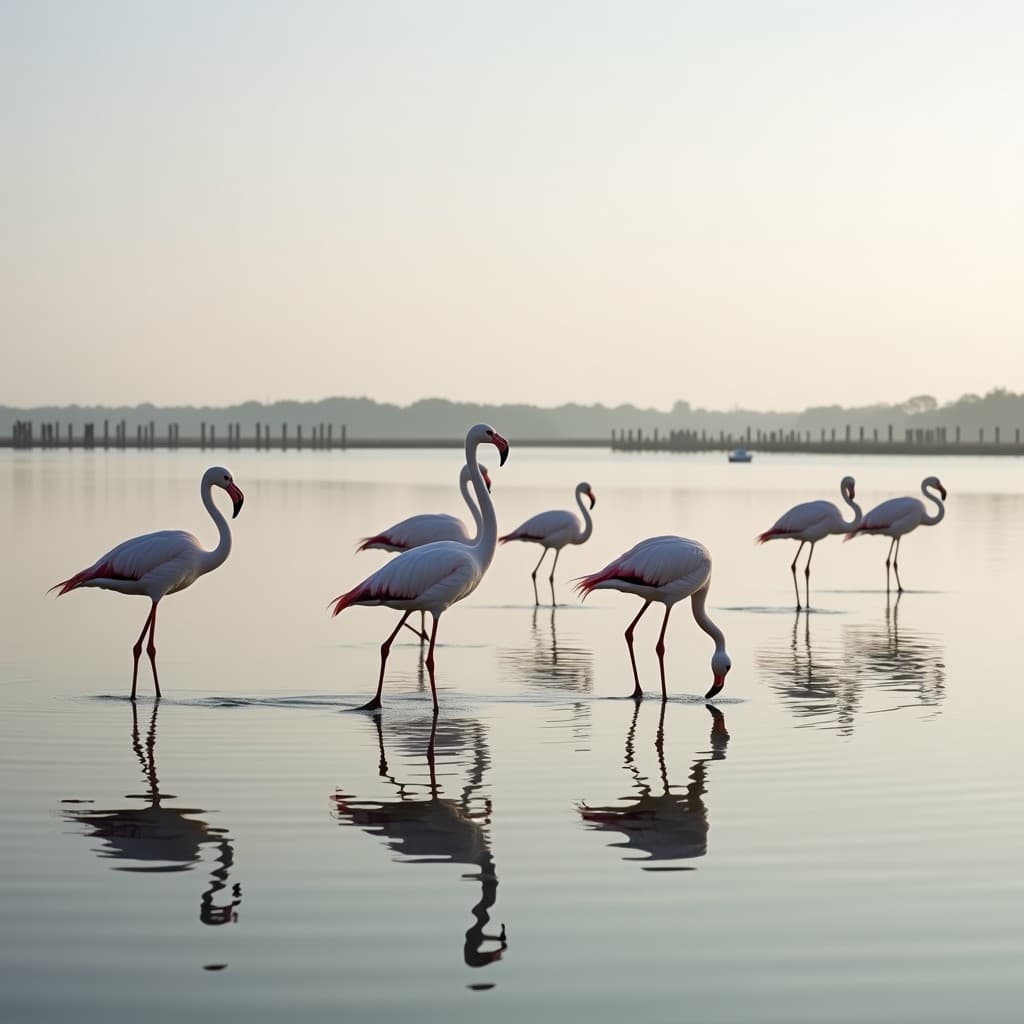
The pale pink birds now frequent the Venetian lagoon in record numbers, according to reporting from AP News and the San Francisco Chronicle. The flamingos—called fenicotteri in Italian—have become so common that their presence marks a visible shift in the lagoon's ecology. What makes their arrival remarkable is that the local Venetian dialect, shaped by centuries of lagoon life, has no native word for them; they are newcomers to a landscape that thought it knew itself.
The birds' expansion coincides with ecological efforts to restore damaged wetlands across the lagoon, efforts that could expand their habitat further and possibly induce them to nest in the region permanently. The restoration work, reported by international outlets, represents a deliberate attempt to reverse decades of environmental degradation in one of Europe's most fragile and closely watched water systems.
For Venice and the Veneto, the flamingo arrival carries symbolic weight. The lagoon has long been framed in the foreign press as a site of decline—sinking, choked with cruise ships, its resident population fleeing. The presence of flamingos, thriving in restored wetlands, offers a counter-narrative: that ecological intervention can work, that the lagoon can recover, that life can return.
The flamingo's colonisation of the Venetian lagoon is not accidental. According to AP News, the birds have been drawn northward from their traditional Mediterranean and African ranges, finding in the lagoon's recovering wetlands the shallow, brackish waters they require. The restoration efforts that created these conditions are part of a broader European commitment to wetland conservation, but in Venice they carry particular meaning.
The lagoon itself is a constructed ecosystem, shaped by Venetian engineering over more than a thousand years. Medieval and Renaissance dike-builders, hydraulic engineers, and administrators transformed a shallow bay into a navigable waterway and a defensible city. That same human hand has, in recent decades, degraded it: industrial development, agricultural runoff, subsidence, and the wake of massive cruise ships have eroded the wetland margins and muddied the water column. The flamingos' return suggests that deliberate restoration can reverse some of that damage.
International environmental coverage has long treated the lagoon as a barometer of European ecological health. UNESCO, which designated Venice and its lagoon as a World Heritage Site in 1987, has monitored its condition closely. The arrival of flamingos in breeding numbers would represent a significant shift in that assessment—from a site of crisis management to one of genuine recovery. Foreign science journalists have tracked similar wetland restoration projects across Europe, from the Camargue in France to the Danube Delta, but Venice's restoration carries the added weight of saving a UNESCO world heritage site.
The economic implications for the Veneto are subtle but real. Tourism to Venice is dominated by day-trippers and cruise passengers focused on the city's monuments and museums. Birdwatching and nature tourism, by contrast, represent a smaller but growing market segment in European travel. The flamingos could attract a different class of visitor—one who spends time in the lagoon's margins, in the fishing villages and nature reserves, rather than rushing through the Basilica di San Marco. This diversification of tourism revenue away from the city centre and toward the lagoon's ecology could ease some of the pressure on Venice's fragile infrastructure.
The restoration efforts themselves are labour-intensive and costly. According to international reporting, they involve reconstructing salt marshes, managing water levels, and controlling invasive species. In the Veneto, these projects employ local workers and contractors, creating economic activity in rural areas that have suffered from agricultural decline. The flamingos, in this sense, are not merely wildlife; they are indicators of investment and employment.
The presence of flamingos also complicates the narrative of Venice as a dying city. Foreign travel writers and cultural critics have long mourned Venice's transformation into a museum, a place where residents are replaced by tourists and authentic life is replaced by performance. The flamingos suggest a different story: that the lagoon, if tended, can become a living system again. That life—non-human life—can flourish in the spaces between the city and the sea.
Yet the flamingos' arrival also raises questions about ecological change and climate. According to the San Francisco Chronicle's reporting, the birds' northward expansion is linked to warming temperatures across the Mediterranean. They are, in a sense, climate migrants, following the isotherms northward as southern wetlands become too hot and dry. Their presence in Venice is thus a sign of both ecological recovery and climate stress—a paradox that international environmental coverage has begun to grapple with.
The lagoon's future depends on managing multiple, sometimes contradictory pressures. The MOSE flood barriers, which have been the subject of intense international scrutiny, are designed to protect Venice from acqua alta, the seasonal high tides that are rising with sea level. But the barriers also restrict water exchange with the Adriatic, which can degrade water quality in the lagoon's interior. The flamingos require both protection from flooding and adequate water circulation—a balance that engineers and ecologists continue to negotiate.
For the Veneto's export industries, the flamingos carry a subtle message about environmental stewardship. The region is known for luxury goods—eyewear, textiles, wine—and for small manufacturing firms that pride themselves on quality and tradition. International buyers increasingly care about the environmental credentials of their suppliers. A lagoon that is recovering, that can support wildlife, that is being actively managed for ecological health, becomes part of the region's brand story. It suggests that Veneto businesses operate in a place that values both heritage and sustainability.
The flamingos also represent a shift in how the foreign press frames the Veneto. For decades, international coverage has emphasised the region's economic dynamism—its small firms, its export success, its design and fashion industries. More recently, coverage has turned to environmental stress: climate change, subsidence, the pressure of mass tourism on Venice. The flamingos offer a third frame: ecological restoration, the possibility of recovery, the lagoon as a site of active environmental management rather than passive decline.
Local naturalists and birdwatchers, though not quoted in the international press accounts, have likely been tracking the flamingo population for years. Their observations feed into international scientific networks and conservation databases, which in turn shape how foreign journalists and policymakers understand the lagoon's condition. The flamingos are thus a meeting point between local knowledge and international attention, between the Venetian lagoon as a lived environment and as a globally significant ecosystem.
The question now is whether the flamingos will establish a permanent breeding population in the lagoon. If they do, they will join a roster of species—cormorants, herons, egrets—that have returned to or expanded in the lagoon as water quality has improved. The lagoon would become not a museum piece or a dying relic, but a dynamic, evolving ecosystem. For Venice and the Veneto, that shift in perception—from decline to recovery—may matter as much as the flamingos themselves.