
VENETO
Pink arrivals: flamingos reclaim Venice's restored wetlands
Record numbers of the birds find habitat in the lagoon as ecological projects reverse decades of damage
Tommaso Veronese1,347 wordsEdition №4Thursday, 4 June 2026 — Edition № 4
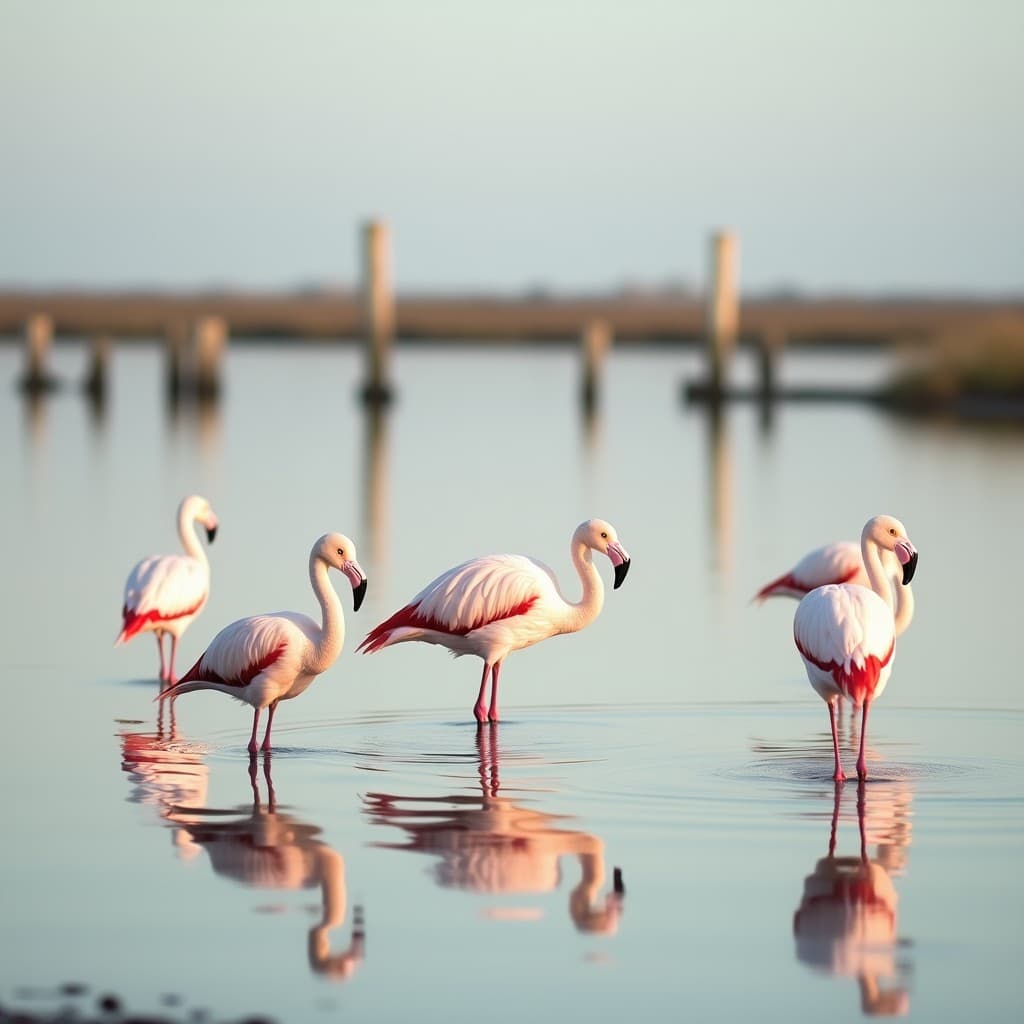
The pale pink birds now congregate across the Venetian Lagoon in record numbers, according to AP reporting from the lagoon in late May. The phenomenon is so recent that the local Venetian dialect has no word for flamingos—they are called "fenicotteri" in standard Italian, a term borrowed from the national language. Their arrival marks a visible shift in the lagoon's ecology, one tied directly to restoration projects that have begun to heal wetlands damaged by industrial development, agricultural runoff, and decades of neglect.
The flamingos' presence signals that the lagoon's capacity to support wildlife is recovering. AP reported that ecological efforts to restore damaged wetlands could help expand their habitat and possibly induce them to nest in the lagoon—a threshold that would mark the species as permanently established in the region. The birds feed in shallow waters and salt marshes, habitats that had contracted sharply as the lagoon was drained, filled, and industrialised throughout the twentieth century.
For Venice and the Veneto, the flamingos represent an unexpected dividend from environmental investment. The lagoon's recovery is not incidental to tourism or heritage preservation—it is foundational to both. A functioning wetland ecosystem supports the fisheries that have sustained the region for centuries, filters water that feeds into the city's canals, and provides the biological stability that underpins the lagoon's fragile equilibrium with the sea.
The appearance of flamingos in significant numbers is a recent phenomenon in the Venetian Lagoon. According to AP's reporting, the birds are "newcomers" to the region, and their arrival has accelerated only in recent years as wetland restoration has gathered pace. The lagoon's capacity to support them had been severely diminished by the mid-twentieth century, when industrial and agricultural pressures transformed vast stretches of salt marsh into industrial zones, fish farms, and agricultural land.
The Venetian Lagoon covers roughly 550 square kilometres and is one of Europe's largest coastal wetland systems. For much of the postwar period, it was treated as an economic resource to be exploited rather than an ecosystem to be preserved. Wetlands were drained for agriculture and industry; channels were deepened for shipping; freshwater inflows were diverted for irrigation and urban use. The result was ecological collapse: fish stocks declined, water quality deteriorated, and the lagoon's ability to filter nutrients and support wildlife contracted dramatically.
The restoration efforts that have begun to reverse this damage are relatively recent. Over the past decade, Italian and European environmental bodies have invested in wetland reconstruction, the reintroduction of native plant species, and the reduction of agricultural runoff. These projects operate at the intersection of heritage preservation and environmental recovery—the lagoon's ecological health is inseparable from Venice's survival as a city. The same processes that degrade the wetlands (subsidence, erosion, nutrient loading) also destabilise the foundations of the city itself.
The flamingos' arrival is thus not merely a wildlife story. It is a visible marker of whether the lagoon's restoration is succeeding. AP noted that the birds' presence in record numbers suggests that conditions have improved enough to support a species that requires specific habitat—shallow, brackish waters with adequate food sources. The fact that they may now nest in the lagoon would represent a fundamental shift: from a species that visits seasonally to one that establishes a breeding population.
The regional economy depends on the lagoon in multiple ways. Tourism generates roughly 40 percent of Venice's GDP, and the city's appeal rests on its unique relationship to water and wetland landscape. The Venetian Lagoon is a UNESCO World Heritage Site, and its ecological integrity is a condition of that designation. Simultaneously, the lagoon supports traditional fisheries—particularly for clams and other shellfish—that remain economically significant in the Veneto despite industrial decline. A recovering wetland ecosystem benefits both sectors.
The flamingos also illustrate a broader pattern in European environmental recovery. As industrial activity has declined in some regions and environmental regulations have tightened, species have begun to recolonise areas they had abandoned. Wolves have returned to the Alps; sea eagles have reappeared in northern Europe; wetland birds have reclaimed drained marshes. The Venetian Lagoon's flamingos fit this pattern, but with a particular urgency: their return is tied to deliberate, costly restoration work rather than passive rewilding.
The restoration projects themselves are technically complex and expensive. They require the reconstruction of salt marshes, the management of water salinity and freshwater inflows, the control of invasive species, and the coordination of multiple stakeholders—municipal authorities, regional governments, environmental organisations, and the Italian state. The work is ongoing and incomplete. Large areas of the lagoon remain degraded, and the restoration of the entire system would require sustained investment over decades.
Climate change adds another layer of complexity. The lagoon faces rising sea levels, which threaten to inundate restored wetlands and accelerate the subsidence of Venice itself. The MOSE flood barrier, completed in 2020, was designed to protect Venice from acqua alta (high water) but does not address the underlying problem of subsidence and sea-level rise. Wetland restoration and the MOSE system operate in tension: the barrier protects the city but can also trap water and sediment in the lagoon, altering the hydrological conditions that wetland species depend on.
The flamingos' arrival also reflects changing patterns of bird migration across the Mediterranean. As wetlands in North Africa and the Middle East have been drained or degraded, migratory species have shifted their routes and wintering grounds. Some species have moved northward into Europe; others have abandoned traditional habitats entirely. The flamingos in the Venetian Lagoon may represent a permanent shift in migration patterns, driven by both climate change and habitat loss elsewhere in the Mediterranean basin.
For the Veneto region, the flamingos carry symbolic weight beyond their ecological significance. Venice has long been mythologised in the foreign imagination as a city suspended between nature and culture, between human artifice and natural forces. The lagoon itself is a product of both: it is a natural system that has been shaped by centuries of human intervention. The flamingos, in their newness and their visibility, embody the possibility that the lagoon can be restored—that the damage of the industrial era can be reversed, and that Venice's relationship to water can be healed.
The AP reporting emphasised the birds' status as newcomers, highlighting the linguistic and cultural fact that Venetian dialect has no word for them. This detail underscores how recent their arrival is, and how far the lagoon has drifted from its historical ecology. In earlier centuries, the lagoon supported a far richer array of waterbirds, fish, and marine life. The flamingos are not a return to a pristine past but a sign that the lagoon is beginning to recover its capacity to support wildlife.
The restoration of the Venetian Lagoon remains incomplete and fragile. Funding is inconsistent; political will fluctuates; climate change poses accelerating threats. But the flamingos suggest that recovery is possible—that even severely damaged ecosystems can begin to heal if the investment is made and sustained. For Venice and the Veneto, their presence is a small but visible sign that the lagoon's future is not yet determined.