
CAMPANIA
Vesuvius preserved a brain in glass; what it tells us now
Scientists studying vitrified tissue from Herculaneum argue the volcano's heat transformed neural matter rather than obliterating it entirely.
Rosaria Esposito1,456 wordsEdition №7Sunday, 7 June 2026 — Edition № 7
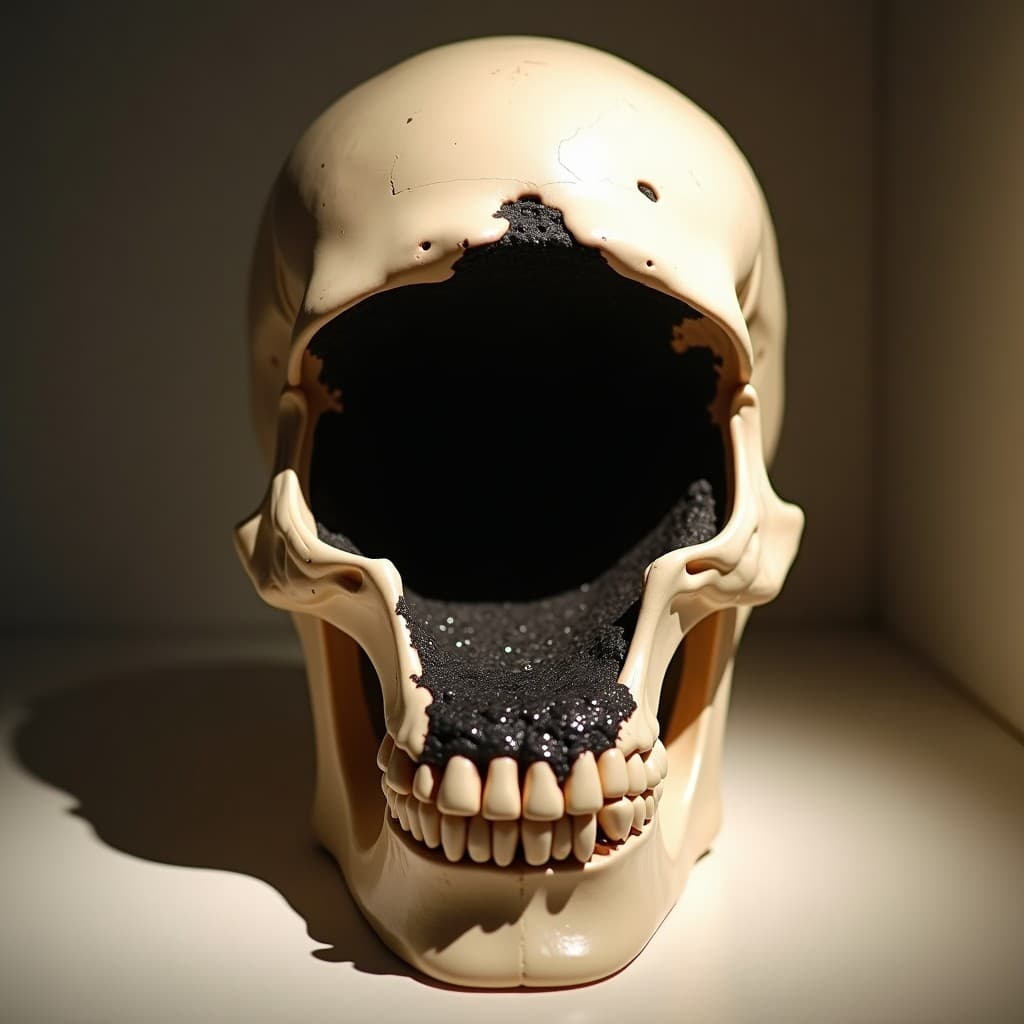
A young male skeleton unearthed from the Collegium Augustalium in Herculaneum has yielded a discovery that reshapes how scientists understand the volcano's lethal mechanism. According to the Times of India, researchers identified a black glass-like mass inside the skull—material they argue is vitrified brain tissue, preserved by the extreme temperatures of the 79 AD eruption. The finding challenges the assumption that Vesuvius's pyroclastic flows simply incinerated the victims it entombed.
The distinction matters. If the brain tissue was indeed crystallised by heat rather than destroyed, it means the eruption's thermal pulse was precise enough to transform organic matter at the molecular level while leaving bone and skull intact. This precision—the ability to preserve even as it kills—offers volcanologists a new window into the eruption's temperature profile and the sequence of events that claimed thousands in seconds.
Herculaneum, situated closer to Vesuvius than Pompeii, absorbed a more violent blast. The discovery at the Collegium Augustalium, a structure linked to the imperial cult, underscores how thoroughly the volcano's reach extended into the city's institutional life. For Campania, where Vesuvius remains an active presence and tourism around its crater and the excavations below sustains thousands of jobs, the finding adds another layer to the story the region tells the world: a place where catastrophe and preservation intertwine.
The research, reported by the Times of India, focuses on remains recovered from one of Herculaneum's most significant structures. The Collegium Augustalium served as a meeting place for officials and wealthy citizens devoted to the imperial cult—men of standing whose sudden death in the eruption left traces that modern science can now interrogate in unprecedented detail. The skeleton belonged to a young male whose body position and the condition of his remains suggest he was caught in the initial surge of superheated gas and ash.
Vitrification—the process by which organic material transforms into a glass-like state under extreme heat—is not unknown to volcanologists. What makes this discovery significant is its location: inside the cranial vault of a human skull. The black glass-like mass identified by researchers suggests temperatures high enough to crystallise brain tissue, a process that requires sustained heat above 300 degrees Celsius. Such temperatures would have been present in the pyroclastic flows that descended from Vesuvius at speeds exceeding 100 kilometres per hour.
The implications extend beyond Herculaneum's archaeology. Understanding how the eruption's thermal energy was distributed through the city helps volcanologists model what similar eruptions elsewhere might produce. Vesuvius is not dormant; it is merely quiet. The 3 million people living in the Naples metropolitan area, many of them in the shadow of the volcano's cone, depend on accurate models of eruption behaviour. Every detail recovered from Herculaneum and Pompeii feeds into the hazard assessments that inform evacuation plans and building codes.
For Campania's tourism economy, the discovery reinforces the region's singular position in global consciousness. Pompeii and Herculaneum are among Italy's most visited archaeological sites, drawing hundreds of thousands of visitors annually who come to witness the moment catastrophe froze a city. Foreign travel media regularly frames these excavations as windows into Roman life—the bread still in ovens, the graffiti on walls, the bodies in their final postures. The vitrified brain tissue adds a new dimension to that narrative: not just the preservation of the mundane, but the crystallisation of the intimate and invisible.
The Times of India report notes that researchers argue the eruption may not have entirely destroyed the victim's neural tissue. This phrasing carries weight. It suggests a spectrum of preservation rather than a binary outcome—total destruction or perfect preservation. In the volcanic context, this nuance matters enormously. It means that Vesuvius's killing mechanism was not simply about burning everything it touched, but about subjecting victims to conditions so extreme that their bodies underwent chemical transformation.
Herculaneum's preservation is famously superior to Pompeii's. The pyroclastic flows that buried the city were hotter and faster, sealing buildings and their contents in a way that Pompeii's ash falls did not. Wooden beams, food, textiles, and papyri survive in Herculaneum in states that would have crumbled to dust elsewhere. The vitrified brain tissue fits this pattern: Herculaneum's particular geological circumstances allowed it to preserve even the most delicate structures, transformed into new states but still legible to modern investigation.
The Collegium Augustalium itself is a structure of considerable historical interest. These collegia were associations of citizens, often of lower status than the aristocracy but elevated above the common population. Their members served religious and administrative functions tied to the imperial cult—the veneration of Rome's emperor as a divine figure. That such a building has yielded skeletal remains with preserved neural tissue speaks to the eruption's indiscriminate reach. Status and wealth offered no protection against Vesuvius.
For the foreign press that covers Italy's South, this discovery lands in familiar territory: the overlap between Italy's classical heritage and its modern vulnerability. Vesuvius is not merely a historical curiosity. It is a present-day risk factor that shapes how 3 million people live and where they can build. News outlets covering Italy's geological hazards—from the BBC to Reuters to Deutsche Welle—regularly return to Vesuvius as a symbol of the region's exposure to natural disaster. The vitrified tissue discovery adds scientific depth to that narrative.
Campania's relationship with Vesuvius is complex. The volcano has shaped the region's soil, making it extraordinarily fertile. The wines of Vesuvius's slopes, the tomatoes and mozzarella that feed Naples's culinary reputation, the very agricultural abundance that sustained the Roman city—all owe something to the volcano's geological legacy. But the eruption of 79 AD is a reminder of the cost of living in such a place. Herculaneum's preservation, even in its violence, has become one of Campania's greatest assets, drawing tourists and scholars, sustaining local economies, and keeping the region's history alive in global consciousness.
The research team's focus on the skull's contents reflects a broader shift in how archaeologists approach Vesuvius's victims. Rather than treating the remains as static artifacts, modern science treats them as sources of biological data. DNA analysis has revealed family relationships among Pompeii's dead. Isotope studies have shown where people originated and what they ate. Now, microscopic examination of vitrified tissue offers insights into the eruption's thermal dynamics and the precise conditions that killed.
The discovery also highlights the ongoing work at Herculaneum. The site remains partially unexcavated; estimates suggest that roughly 25 percent of the ancient city still lies buried beneath modern Naples and its suburbs. Each new excavation, each new analytical technique applied to existing remains, adds to the picture of life in the first century AD and the catastrophe that ended it. The vitrified brain tissue is not an isolated curiosity but part of a cumulative body of evidence that continues to reshape our understanding of the eruption.
For Campania's cultural institutions and tourism boards, the discovery offers fresh material for interpretation. Museums in Naples and at the Pompeii and Herculaneum sites will likely incorporate the finding into their displays and educational programs. The narrative of preservation—how Vesuvius froze a moment in time—gains new scientific credibility when the preservation extends to the cellular level, to structures as delicate and ephemeral as neural tissue.
Looking forward, the research raises questions about what other remains might yield to similar analysis. If brain tissue survived in this skull, what else might be preserved in the thousands of other remains recovered from Herculaneum and Pompeii? The Times of India's report suggests that this discovery may be the beginning of a new phase of investigation, one in which modern analytical techniques are applied systematically to remains that have been in museums for decades or even centuries. The volcano's victims, after nearly two thousand years, may still have stories to tell.