
SPORT
Italian tennis finds depth beyond Sinner as three men reach French Open last eight
Berrettini, Arnaldi and Cobolli advance without world No. 1, raising questions about the talent pipeline
Tobia Marenghi1,247 wordsEdition №6Saturday, 6 June 2026 — Edition № 6
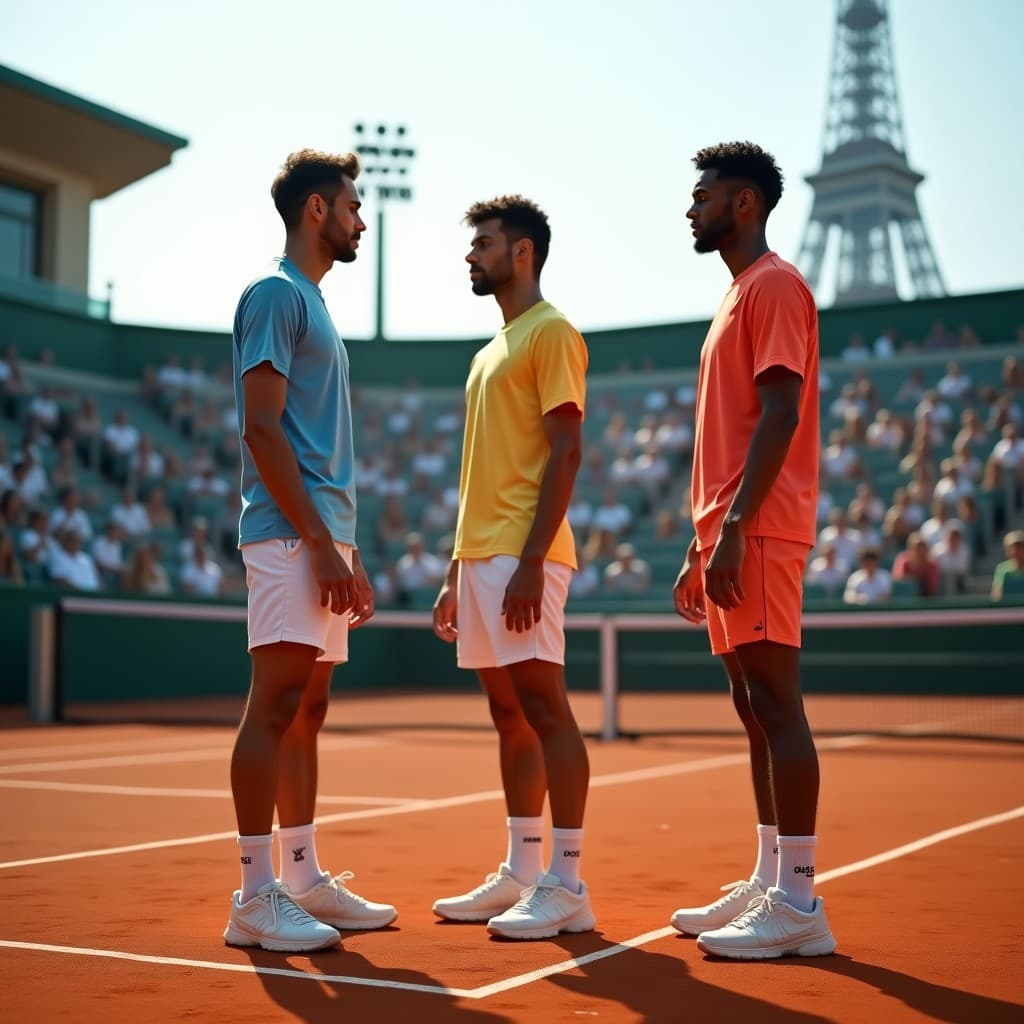
For the first time in the modern era, three Italian men have reached the quarterfinals of the French Open in the same year. Matteo Berrettini will face Matteo Arnaldi in Wednesday's night session — guaranteeing at least one Italian in the semifinals — while Flavio Cobolli meets Canada's Felix Auger-Aliassime in the same half of the draw. The achievement arrives without Jannik Sinner, the world No. 1 and four-time Grand Slam champion, who fell in the second round to an opponent ranked outside the top 50.
According to the Associated Press, Sinner's early exit marked a significant upset at Roland Garros, where he had been considered among the tournament favourites. The Italian has since travelled to Turin for in-depth medical examinations to determine the cause of recent health problems, according to reporting from Telecom Asia Sport. His absence from the latter stages has thrown the spotlight onto the depth of Italian men's tennis — a question that seemed unresolved as recently as last year.
Berrettini, a former world No. 10 and two-time Grand Slam finalist, has rebuilt his ranking after injury derailed his career trajectory. Arnaldi, 23, represents the emerging generation that Italian tennis has struggled to develop consistently. Cobolli, also in his early twenties, completes a trio that suggests the federation's youth development programmes are beginning to yield results beyond Sinner's dominance.
The last time three Italian men reached a Grand Slam quarterfinal was at the 1960 Italian Open — a tournament held on home soil in Rome, not a major championship. The French Open quarterfinals represent a higher threshold. Sinner's breakthrough to world No. 1 and multiple Grand Slam titles had masked a troubling gap in Italian men's tennis: the absence of a credible second wave of players capable of competing at the highest level.
That gap now appears to be narrowing, though the timing is complicated by Sinner's withdrawal. The BBC's Formula 1 correspondent Andrew Benson has noted in broader sports coverage that Italian sport has historically struggled with succession planning, a pattern that extends beyond tennis. The emergence of Berrettini, Arnaldi and Cobolli suggests a different trajectory — one where investment in junior development is beginning to compound.
Berrettini's path to the quarterfinals is particularly significant. The 28-year-old had fallen as low as world No. 150 following wrist injuries that threatened to end his career. His recovery to compete at Grand Slam level again demonstrates the resilience required to sustain a professional tennis career. His matchup with Arnaldi is a generational collision: the veteran attempting to reclaim lost ground against a younger player who has grown up in Sinner's shadow.
Arnaldi's presence in the quarterfinals carries its own weight. At 23, he represents the cohort of Italian juniors who came through the federation's academies while Sinner was ascending. The fact that he has reached the last eight at Roland Garros without the gravitational pull of a dominant compatriot suggests he has developed his game on its own merits, not merely as a secondary beneficiary of Italian tennis's renewed prominence.
Cobolli, similarly young, faces a Canadian opponent in Auger-Aliassime who has also struggled to convert early promise into sustained Grand Slam success. The match represents an opportunity for the Italian to prove that his ranking — currently outside the top 30 — understates his potential at the majors. If he advances, the narrative of Italian depth strengthens considerably.
Sinner's medical examinations in Turin will determine whether his second-round exit represents a temporary setback or a symptom of deeper issues. According to Telecom Asia Sport, the Italian wants to assess his current condition thoroughly before committing to upcoming tournaments. The timing is delicate: the Wimbledon Championships begin in three weeks, and Sinner has won that tournament before.
The federation faces a strategic question. If Sinner returns to full fitness, the presence of Berrettini, Arnaldi and Cobolli in the latter stages of major tournaments could relieve pressure on him to carry the entire burden of Italian men's tennis. If his health issues prove more persistent, the depth now visible at Roland Garros becomes essential rather than supplementary.
Historically, Italian tennis has cycled between periods of strength and drought. Adriano Panatta won the French Open in 1976 — the last Italian man to claim a major title until Sinner's breakthrough. That 50-year gap underscores how rare sustained success has been. The current moment, with three men in the quarterfinals, suggests the federation has learned from that history of feast and famine.
The international press has noted the contrast between Italy's depth in women's tennis — where Jasmine Paolini and others have reached major finals — and the historical weakness in the men's game. The French Open quarterfinals represent a narrowing of that gap. Whether this becomes a trend or a one-off anomaly will depend on whether Berrettini, Arnaldi and Cobolli can sustain their performance over the next five years.
For the Italian federation, the immediate priority is ensuring that Sinner's recovery does not overshadow the achievement of his peers. The narrative of Italian tennis has been dominated by one player for so long that the emergence of alternatives feels almost novel. The quarterfinals at Roland Garros offer proof that the pipeline exists — that Italian tennis is not a one-man operation but a sport with genuine structural depth.
The matches ahead will test that depth. Berrettini versus Arnaldi is a domestic clash that guarantees an Italian semifinalist; the winner will face either Cobolli or Auger-Aliassime. If both Italians advance, the semifinals would feature two Italians in the same half of the draw — a scenario that seemed improbable just weeks ago, when Sinner was the only Italian expected to reach the latter stages.
The regional consequence for Italian sport is significant. Tennis has become a vehicle for soft power and national pride, particularly as Italy's football team rebuilds after missing the World Cup. The presence of three men in the French Open quarterfinals offers a counternarrative to the Azzurri's absence from Qatar and the upcoming tournament in North America. Sport, in Italy's international profile, is increasingly about what happens beyond football.