
LAZIO
Italy marks 80 years of the Republic with military ceremony in Rome
The capital hosts national commemoration of the 1946 vote that ended monarchy and established democracy
Davide Ruspoli1,247 wordsEdition №4Thursday, 4 June 2026 — Edition № 4
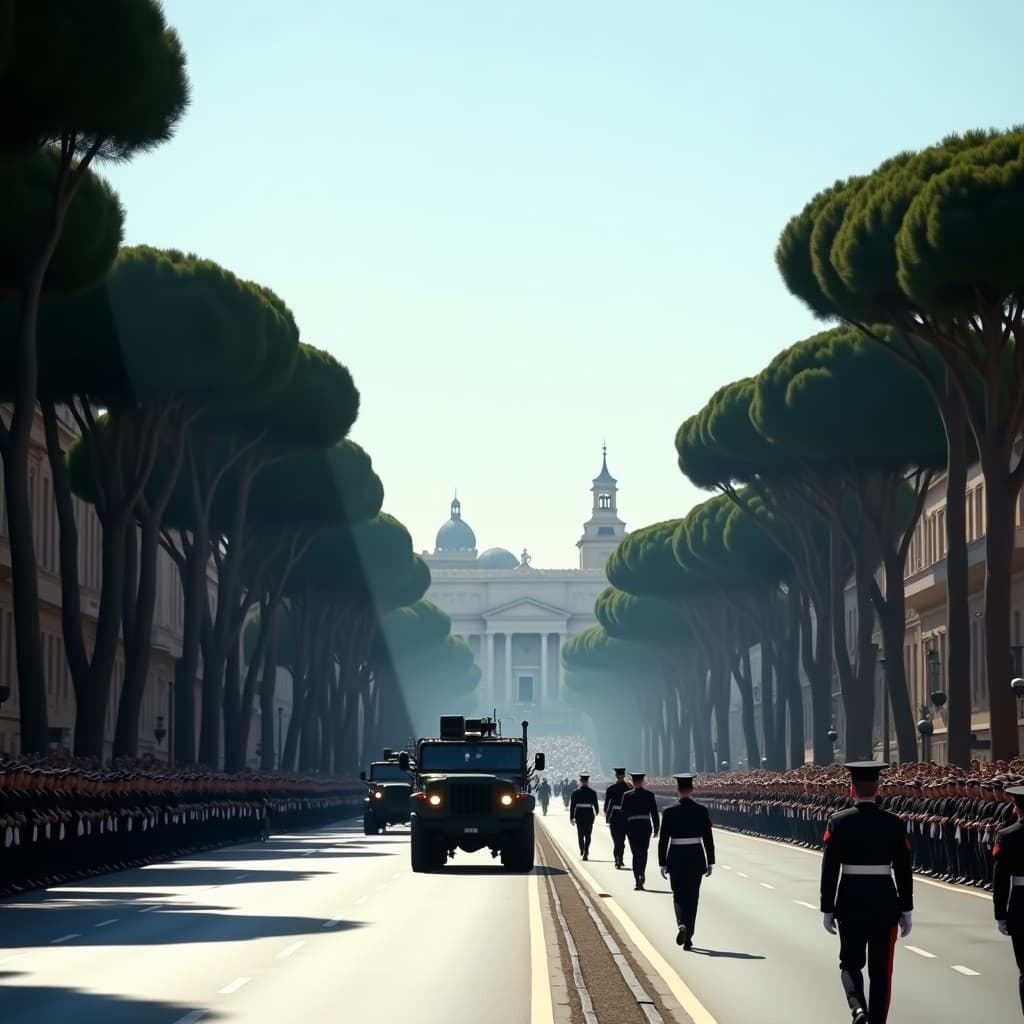
Italy marked the 80th anniversary of the birth of the Republic on June 2 with ceremonies, military parades and flypasts in Rome, according to Euronews. The commemoration centred on the 1946 vote that paved the way for democracy, ending the Fascist era and the monarchy that had ruled the peninsula for nearly a century.
The date—June 2—holds constitutional weight in the Italian state. It commemorates the 1946 referendum in which Italian voters chose a republican form of government over the restoration of the House of Savoy. That vote, held in the immediate aftermath of World War II, established the framework for the Constitution adopted two years later and remains the founding act of the modern Italian state.
Rome, as the seat of government and the symbolic centre of the Italian state, hosted the principal national ceremony. The military parade and flypasts underscored the institutional character of the commemoration, framing the Republic as a settled constitutional order rather than a contested political project.
The 80th anniversary arrives at a moment when the Italian state faces familiar pressures. Foreign coverage of Italy in recent years has focused on political turnover, public debt, demographic decline and the strains of migration across the Mediterranean. The Republic Day ceremony, held annually on June 2, offers the state an opportunity to reaffirm its institutional continuity and democratic legitimacy.
The 1946 referendum was itself a watershed. Italians voted to replace the monarchy with a republic in a plebiscite held on June 2 and 3, 1946. The result was decisive: roughly 54 per cent voted for the republic, 46 per cent for the monarchy. The vote took place amid the ruins of Fascism and war, in a country occupied by Allied forces and facing economic collapse. The choice of a republican form reflected both a rejection of the old order and a desire to align Italy with the democratic states of Western Europe.
The Constitution that followed, adopted in 1948, established a bicameral Parliament, a President elected by Parliament, and a Constitutional Court. It enshrined civil rights, labour protections and the principle of subsidiarity—devolving power to regions and local authorities. The document was designed to prevent the concentration of executive power that had enabled Mussolini's dictatorship.
From Rome's perspective, the Republic Day ceremony serves multiple functions. It affirms the capital's role as the seat of state power and the symbolic heart of the nation. The military parade, traditionally held along the Via dei Fori Imperiali, connects ancient Rome to the modern state, suggesting historical continuity and institutional permanence. The flypasts—typically involving the Italian Air Force—project state power and national pride.
The timing of the 80th anniversary also invites reflection on the durability of the republican order. Eight decades is a significant span in European history. The Italian Republic has survived economic crises, political scandals, organised crime, terrorism, and repeated changes of government. Foreign correspondents covering Italy often emphasise political instability—the frequency of government turnover, the fragmentation of Parliament, the rise of populist and anti-establishment parties. Yet the institutional framework itself has endured.
The foreign press has noted Italy's role within the European Union and NATO as a stabilising factor. Despite domestic political volatility, Italy has remained anchored to Western institutions and the European project. The Republic Day ceremony, in this reading, reaffirms that institutional commitment.
The Lazio region, as the home of Rome and the seat of the Italian state, bears particular symbolic weight on Republic Day. The ceremonies held in the capital are national events, but they are also regional ones. Rome's role as the capital has shaped its economy, its culture, and its relationship to the Italian state. Tourism, government employment, and the presence of the Vatican are central to the regional economy. The Republic Day parade draws visitors and media attention, reinforcing Rome's position as the symbolic and administrative centre of the nation.
The military parade itself reflects the structure of the Italian state. The armed forces—the Army, Navy, Air Force and Carabinieri—march in formation, displaying the instruments of state power. The parade is televised and widely attended, making it a moment of public ritual and national identification. For Rome, it is also a major civic event, requiring security preparations, crowd management, and coordination among city authorities.
The 1946 referendum, which the June 2 ceremony commemorates, was also a moment of female political participation. Italian women voted in a national election for the first time in 1946, in the referendum on the form of government. This historical fact is often noted in foreign coverage of the anniversary, as it connects the founding of the Republic to the expansion of democratic rights.
The Constitution adopted in 1948 included provisions on regional autonomy that have shaped Lazio's governance. Five regions—Sicily, Sardinia, Trentino-Alto Adige, Valle d'Aosta, and Friuli-Venezia Giulia—received special autonomous status. Lazio, as a non-autonomous region, is governed under the standard regional framework, with a regional president and council elected by popular vote. The relationship between Rome as the capital and Lazio as a region has been a recurring theme in Italian politics and administration.
The Republic Day ceremony also marks a moment when the Italian state reflects on its international standing. Italy is a member of the G7, the G20, the European Union, the eurozone, NATO and the Schengen Area. These memberships represent the outcome of choices made in the post-war period, when Italian leaders chose to align the new Republic with Western institutions. The military parade, in this context, affirms Italy's role as a NATO member and a European power.
Foreign coverage of the anniversary has emphasised the resilience of the republican order. Despite economic difficulties, political fragmentation, and social challenges, the Italian state has maintained its institutional framework and its commitment to democratic governance. The June 2 ceremony is an occasion to reaffirm these commitments and to project continuity into the future.
The presence of military flypasts and the scale of the parade also reflect Italy's defence capabilities and its role in European security. NATO membership and defence spending are recurring themes in international coverage of Italy. The Republic Day ceremony provides an opportunity to display military capacity and to underscore Italy's security commitments.
For Rome as a city, the June 2 ceremony is also a moment of civic pride and institutional affirmation. The capital hosts the ceremony, provides the setting, and draws national and international attention. The Via dei Fori Imperiali, the route of the parade, connects the ancient Roman Forum to the modern state, suggesting a historical continuity that extends from the classical world through the Fascist era to the present democratic Republic.