
ABRUZZO
Philippines Earthquake Echoes L'Aquila's Unfinished Reckoning with Disaster
A 7.8-magnitude quake kills 37 and displaces thousands; Abruzzo's own seismic history offers hard lessons on recovery, trust, and the long arc of reconstruction.
Marco Di Sante1,421 wordsEdition №10Wednesday, 10 June 2026 — Edition № 10
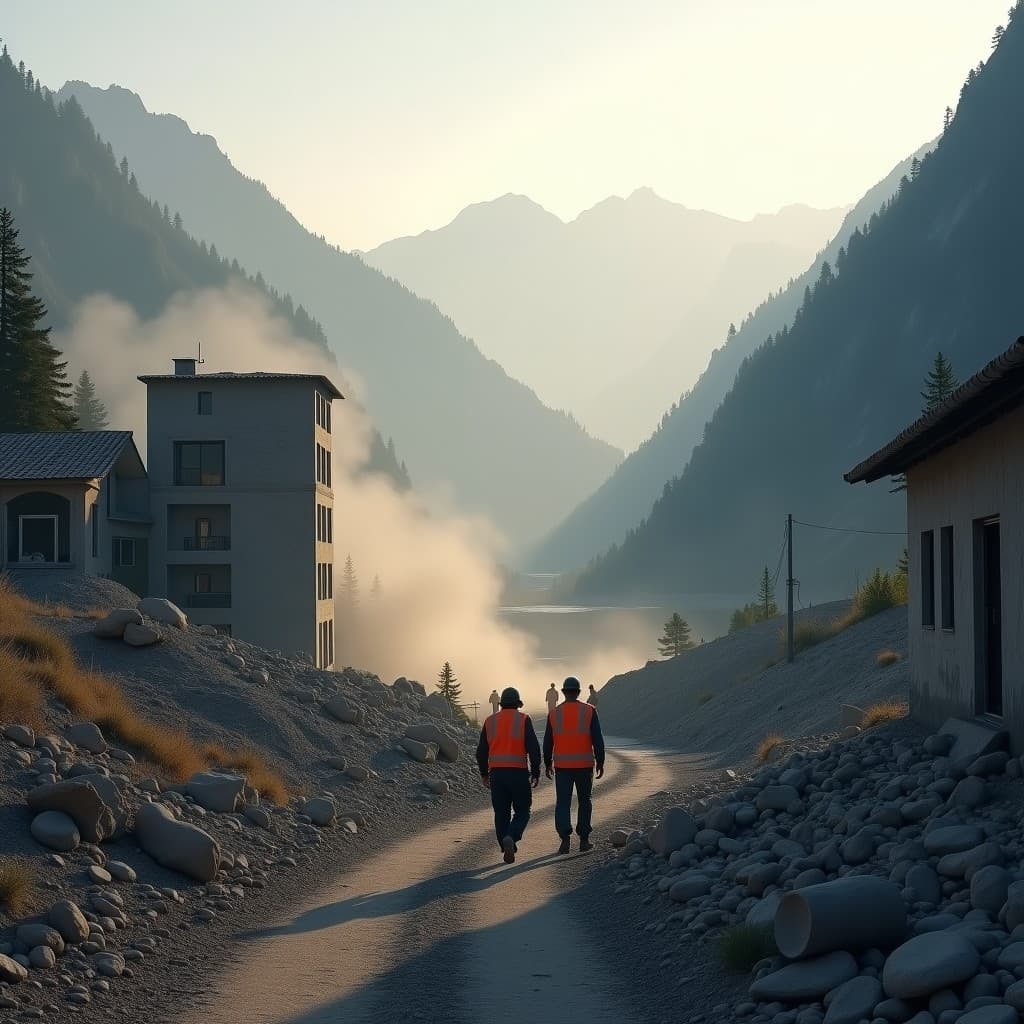
A powerful 7.8-magnitude earthquake struck the Mindanao region in the southern Philippines on June 8, triggering a tsunami and collapsing buildings across the region, according to reporting from CNN and the BBC. Rescuers searched ruined buildings the following day to ensure no one remained trapped. At least 37 people were confirmed dead, with over 20,000 displaced, according to AP News. The scale of destruction and displacement echoes the seismic events that have periodically reshaped the Mediterranean and its margins, including the 2009 earthquake that devastated L'Aquila and the surrounding Abruzzo region.
For those who lived through L'Aquila's earthquake seventeen years ago, the images from the Philippines carry a particular weight. The collapse of buildings, the search through rubble, the displacement of entire communities, the initial chaos of rescue operations—these are scenes that Abruzzo knows intimately. The 6.3-magnitude quake that struck L'Aquila on April 6, 2009, killed 309 people and left much of the medieval city in ruins. It also set in motion a reconstruction process that would stretch across decades and test the capacity of the Italian state to rebuild not just buildings but communities and trust.
The Philippines disaster unfolds in a different political and economic context than L'Aquila did in 2009. The Philippines is a lower-income country with less developed infrastructure and fewer resources for rapid reconstruction. Yet the fundamental challenge is the same: how to restore not just physical structures but the social fabric and economic relationships that earthquakes tear apart. L'Aquila's experience offers both cautionary lessons and some hard-won insights into what reconstruction actually requires.
The 2009 L'Aquila earthquake struck at 3:32 a.m. on April 6, a Monday morning when most of the city was asleep. The quake lasted less than a minute, but it was violent enough to reduce much of the medieval city center to rubble. The death toll of 309 made it the deadliest earthquake in Italy in decades. Entire families were killed in the collapse of apartment buildings. The historic center, with its Renaissance churches and medieval piazzas, was devastated. Survivors emerged into streets filled with dust and the sound of alarms.
The immediate response was chaotic but ultimately effective. Italian civil protection forces mobilized rapidly, setting up tent cities and emergency shelters. International rescue teams arrived within hours. The initial phase of rescue and emergency response lasted weeks, with teams searching through rubble for survivors. But as the acute emergency phase ended, a more complex and contested process began: the reconstruction of the city and the restoration of normal life.
L'Aquila's reconstruction has been marked by tension between different visions of what the city should become. The Italian government, under Prime Minister Silvio Berlusconi at the time, committed substantial resources to rebuilding. Yet the process was slow, bureaucratic, and often frustrating for residents. Disputes arose over how to rebuild the historic center, whether to prioritize restoration of medieval structures or to create a more modern city, how to manage the influx of reconstruction money, and how to prevent corruption and inefficiency.
Seventeen years after the earthquake, L'Aquila remains only partially reconstructed. The historic center is still largely empty, with many buildings still undergoing restoration or awaiting funding. The population has declined from about 73,000 before the earthquake to roughly 67,000 today. Young people have left; businesses have relocated. The tent cities that housed survivors in the immediate aftermath have long since been dismantled, but the psychological and social wounds remain visible in the city's half-empty streets and the sense of incompleteness that pervades daily life.
The reconstruction process exposed deep problems in Italian governance and in the relationship between the state and citizens in disaster recovery. Corruption was a persistent problem, with some contractors and officials exploiting reconstruction funding for personal gain. Bureaucratic delays meant that some residents waited years for their homes to be repaired or rebuilt. The process of determining who was eligible for reconstruction aid, and on what terms, became a source of conflict and resentment. Some residents felt abandoned by the state; others felt that the reconstruction process was being manipulated for political purposes.
Trust in institutions was damaged by the earthquake and further eroded by the reconstruction process. The Italian government's handling of the disaster became a political issue, with opposition parties criticizing the pace and effectiveness of reconstruction. The Berlusconi government was accused of using reconstruction funds for political purposes and of favoring some regions or constituencies over others. These tensions contributed to broader public skepticism about the state's capacity to manage crises and to act in the public interest.
The L'Aquila experience also revealed the social and psychological dimensions of disaster recovery that are often overlooked in discussions of reconstruction. The earthquake did not just destroy buildings; it fractured communities and displaced people from their homes, their neighborhoods, and their social networks. The process of rebuilding is not just a matter of constructing new buildings; it is also a matter of restoring the relationships and sense of belonging that make a place a home. This process is slow, difficult, and cannot be accomplished through government programs alone.
For the Philippines, these lessons suggest some of the challenges that lie ahead. The immediate task of rescue and emergency response will give way, in a matter of weeks or months, to the longer and more difficult work of reconstruction. The Philippines government will face pressure to rebuild quickly, to restore normal economic activity, and to prevent the disaster from becoming a permanent setback to development. Yet the experience of L'Aquila suggests that rushing reconstruction, or prioritizing speed over careful planning and community input, can create problems that persist for decades.
The Philippines also faces challenges that L'Aquila did not. The country is more vulnerable to natural disasters, with typhoons, floods, and earthquakes all posing regular threats. The infrastructure is less developed, and resources for reconstruction are more limited. The political system is less stable, and corruption is a more persistent problem. These factors suggest that reconstruction in the Philippines may be even more difficult and prolonged than it was in L'Aquila.
Yet there are also reasons for cautious optimism. The international community has learned from previous disasters and has developed better frameworks for disaster response and reconstruction. The Philippines has experience with disaster recovery from previous earthquakes and typhoons. Local communities and civil society organizations have developed capacity for disaster response and reconstruction. These factors may help to accelerate recovery and to prevent some of the problems that plagued L'Aquila's reconstruction.
For Abruzzo, the Philippines earthquake is a reminder of the fragility of life in seismic zones and the long-term consequences of disaster. The region remains vulnerable to earthquakes, and the memory of 2009 remains fresh in the minds of residents. The ongoing reconstruction of L'Aquila serves as a visible reminder of how slowly disaster recovery can proceed and how difficult it is to restore a community after catastrophe. Yet it also serves as a testament to human resilience and the capacity of communities to rebuild, even when the process is slow and frustrating.
The international response to the Philippines earthquake will likely follow patterns established by previous disasters. Rescue teams from multiple countries will arrive to search for survivors. International organizations will coordinate humanitarian aid. Governments will pledge reconstruction funding. Yet the real test will come in the months and years ahead, as the acute emergency phase gives way to the long process of rebuilding. The Philippines, like L'Aquila, will need to navigate the difficult balance between the desire to rebuild quickly and the need to do so in a way that restores not just buildings but communities and trust in institutions.
For residents of Abruzzo, watching the Philippines disaster unfold carries a particular resonance. They know from experience what lies ahead for the people of Mindanao: the long nights in emergency shelters, the slow process of clearing rubble, the bureaucratic struggles to access reconstruction aid, the gradual realization that some things cannot be rebuilt. They also know that recovery is possible, even if it is slow and incomplete, and that communities can find ways to move forward even after catastrophe. That knowledge, hard-won through years of struggle, may be one of the most valuable lessons that L'Aquila can offer to the Philippines as it begins its own long journey of reconstruction.