
LAZIO
Pope Leo frames migration as spiritual crisis in Spanish parliament address
Vatican shifts papal diplomacy toward Europe's political frontlines as pontiff warns of global cultural breakdown
Davide Ruspoli1,247 wordsEdition №10Wednesday, 10 June 2026 — Edition № 10
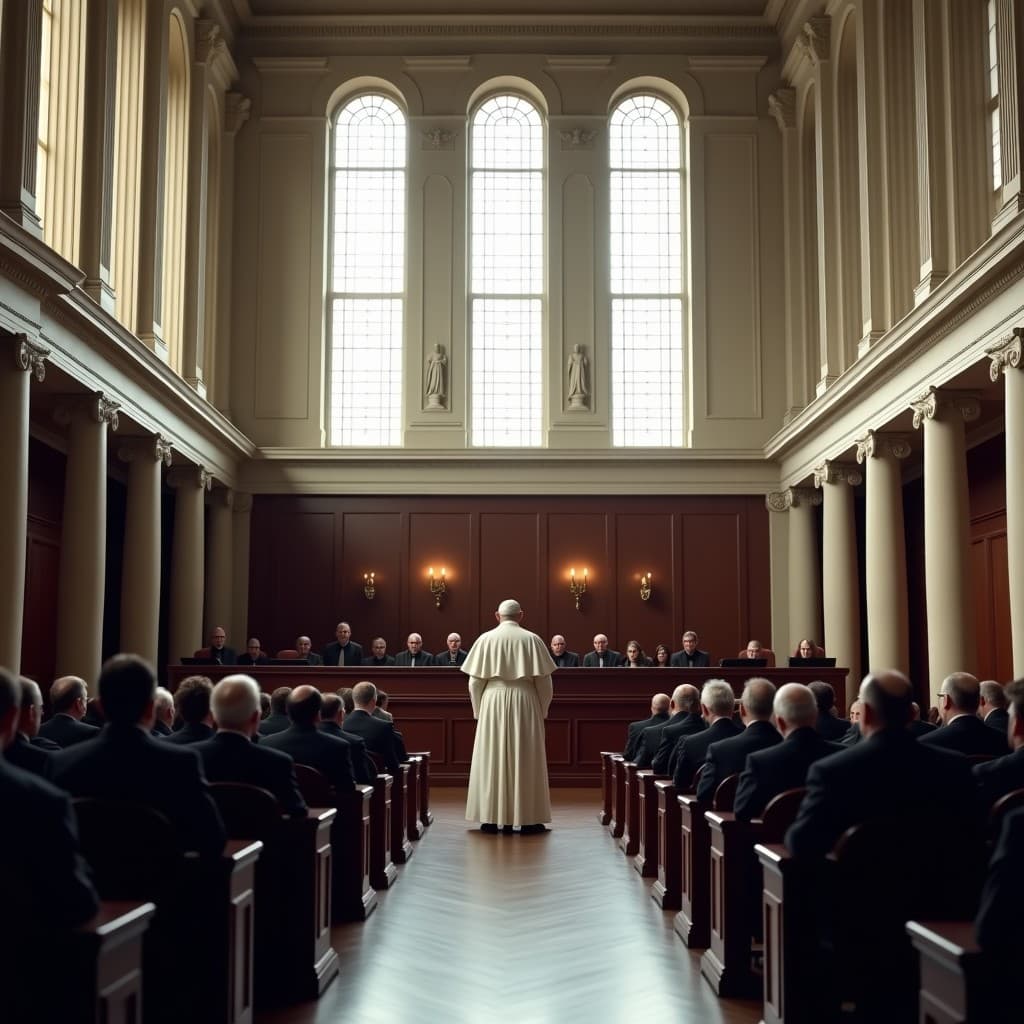
Pope Leo XIV addressed the Spanish parliament on Monday with a sweeping warning that the world faces a "deep spiritual and cultural crisis," using the platform to reframe migration not as a border-management problem but as a moral and theological emergency. According to the Guardian, the pontiff urged the international community to "tackle the causes and consequences of what he termed the tragic drama of migration." The speech marked the first papal address to Spain's lawmakers and came as the Socialist-led government navigates political crisis and the country absorbs significant migrant flows from North Africa.
The Vatican's framing reflects a deliberate shift in papal diplomacy under Leo XIV, who has made migration a centrepiece of his early pontificate. AP News reported that the Pope's tour of Europe's migration hotspots aims to "ease political tensions" by redefining the debate in moral rather than nationalist terms. The pontiff's appearance in Madrid follows weeks of messaging from Rome that positions the Church as a counterweight to what Vatican officials view as the securitisation of migration policy across the EU.
From Rome, the speech reads as a calculated intervention in European politics at a moment when migration dominates electoral cycles and government stability. The Vatican's investment in this messaging—sending the pontiff to Spain, a country where the Catholic Church's historical legacy remains contested—suggests the Holy See is betting that papal moral authority can shift how secular governments approach asylum and border control. The timing coincides with rising anti-immigration sentiment across the continent and growing friction within EU member states over burden-sharing.
The Pope's address to the Spanish parliament carried symbolic weight beyond its immediate audience. AP News noted that Leo XIV's trip brought him to "a traditional centre of European Christianity, where the Catholic Church has a complex legacy," a reminder that Spain's relationship with Catholicism is neither straightforward nor universally affirmed. The Socialist government in Madrid has pursued secular policies that have marginalised the Church's institutional role, yet the parliament granted the pontiff its podium—a gesture that signals both the Church's residual diplomatic standing and the Spanish government's calculation that papal moral authority might help legitimise difficult immigration policies to domestic constituencies.
The Pope's framing of migration as a spiritual crisis rather than a security threat represents a direct challenge to the language dominant in European capitals. By invoking "spiritual and cultural crisis," Leo XIV rejects the vocabulary of invasion, burden, and threat that has shaped migration discourse in Spain, Italy, Hungary, and Poland. The Guardian reported the Pope's call for "respect for migrants," a formulation that implicitly critiques the deterrence-based policies that have become standard across the EU.
For Rome and the Vatican, the speech serves multiple purposes. First, it positions the Church as a moral arbiter in debates where secular institutions—governments, parties, courts—have become polarised. Second, it attempts to depoliticise migration by locating its causes in spiritual rather than economic or geopolitical factors, a move that sidesteps the nationalist-versus-cosmopolitan divide that structures European politics. Third, it signals to Catholic voters across Europe that the Church offers a third way between right-wing nativism and left-wing open-borders rhetoric.
The timing of the Pope's Spanish tour is inseparable from Italy's own migration crisis. The Chicago Tribune reported on Sunday that Italian rescuers recovered 10 bodies after a migrant boat capsized off Malta, with a fishing vessel rescuing 48 survivors from a vessel that had departed from Libya with approximately 60 people aboard. This incident—one of dozens that occur monthly in Mediterranean waters—underscores the human cost of the policies the Pope is now critiquing from Madrid.
Italy's coastguard and rescue services operate at the frontline of European migration policy, and the Pope's moral framing carries particular resonance in Rome. The Italian government has oscillated between humanitarian rescue operations and restrictive asylum policies, often simultaneously. By speaking to the Spanish parliament about migration's spiritual dimensions, Leo XIV implicitly addresses the Italian political establishment as well—a reminder that the Church views migration management through a theological rather than administrative lens.
The Pope's speech also arrives at a moment when Italy's relationship with the Vatican on migration policy has grown complex. The Italian government has cooperated with Vatican-affiliated NGOs in rescue operations while simultaneously pursuing bilateral agreements with Libya and Tunisia to prevent departures. The Pope's emphasis on "respect for migrants" and the causes of migration—poverty, conflict, climate stress—implicitly critiques the deterrence-based approach that Rome has adopted in recent years.
From a diplomatic standpoint, the Pope's visit to Spain and his messaging on migration represent a Vatican strategy to influence European policy through moral suasion rather than institutional pressure. The Church lacks formal power in EU governance, but it retains symbolic authority and pastoral reach across Catholic populations. By positioning the pontiff as a voice for migrants and against what he frames as a civilisational crisis, the Vatican attempts to mobilise Catholic voters and to shame secular governments into reconsidering their approach.
The New York Times reported that the Pope and Spanish Prime Minister Pedro Sánchez, who met during the visit, have both recently clashed with President Trump, suggesting that the Vatican is also calibrating its diplomatic posture toward the United States. The alignment between the Spanish Socialist government and the Pope on migration—and their joint distance from Trump—hints at a broader Vatican strategy to position the Church as a defender of international law and human rights against what Rome views as American unilateralism.
For Lazio and Rome specifically, the Pope's words carry institutional weight. The Italian capital is both the seat of the Italian state and the home of the Vatican, a duality that shapes how migration policy is debated and implemented. When the Pope speaks to foreign parliaments about migration, he is also speaking to the Italian government, which must reconcile its EU obligations with its Vatican neighbour's moral claims.
The Pope's framing of migration as a spiritual crisis also reflects a longer Vatican tradition of viewing social problems through theological rather than technocratic lenses. By invoking spiritual and cultural breakdown, Leo XIV positions the Church as uniquely equipped to diagnose and address the root causes of migration—a claim that implicitly elevates the Vatican's role in European governance beyond its formal institutional status.
The speech's reception in Spain and across Europe will likely shape how the Vatican calibrates its migration messaging in coming months. If the Pope's moral authority proves persuasive with Spanish lawmakers and voters, the Vatican may intensify its intervention in European migration debates. If the speech is dismissed as naive or irrelevant to the practical challenges of border management, the Church may retreat to a more defensive posture.
From Rome's vantage point, the Pope's Spanish tour represents a high-stakes gamble: that moral suasion can reshape European policy on one of the continent's most divisive issues. Whether the Vatican's spiritual framing of migration can compete with the nationalist and security-focused language that dominates European politics remains an open question—one that will be tested in the months ahead as migration continues to shape electoral outcomes and government stability across the EU.