
LAZIO
Pope Leo's Migration Tour Reframes Vatican's Global Role
American pontiff's Spain visit signals shift in Church's diplomatic priorities as Rome watches institutional implications
Davide Ruspoli1,547 wordsEdition №9Tuesday, 9 June 2026 — Edition № 9
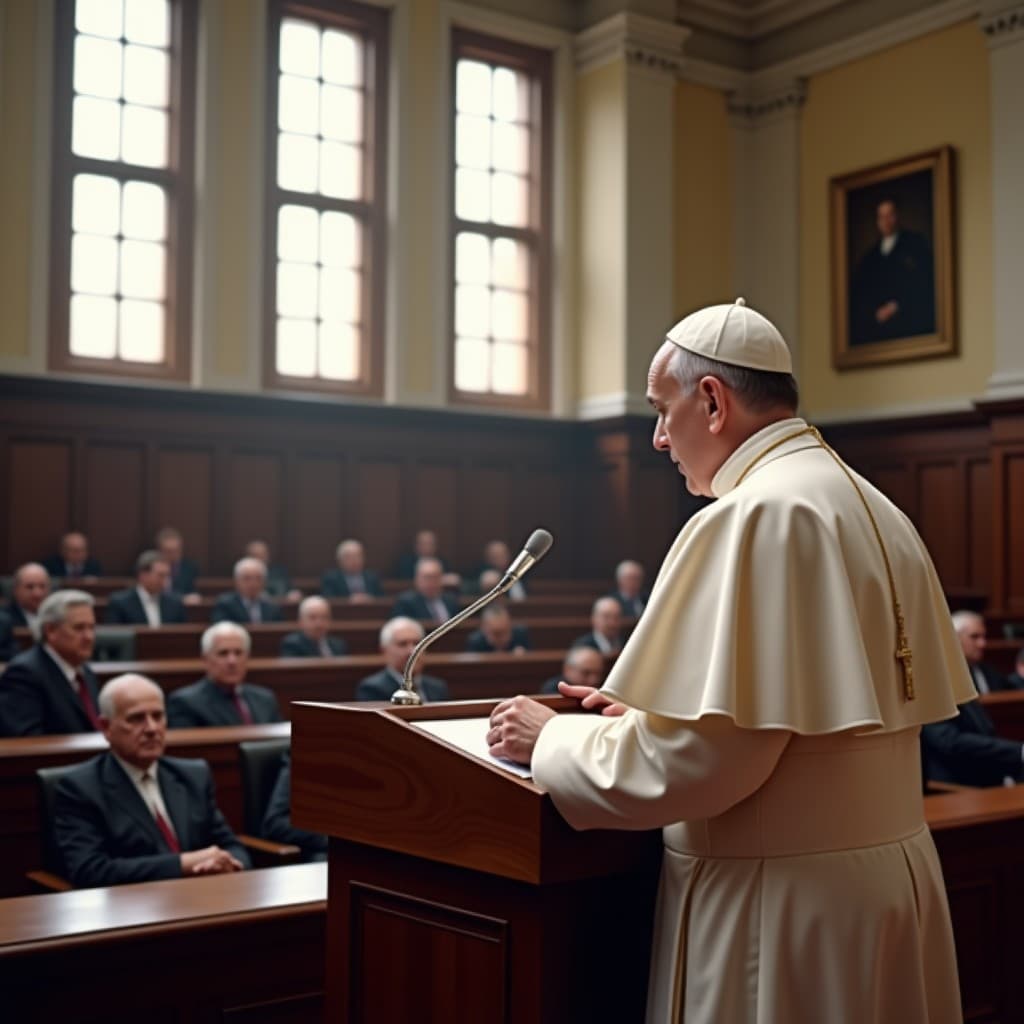
Pope Leo XIV arrived in Spain on Saturday for what the Guardian described as his first visit to an EU country outside Italy, a journey centred explicitly on migration and what he termed in a Madrid address to lawmakers a "deep spiritual and cultural crisis" gripping the world. The American pontiff, who inaugurated a new tower at Barcelona's Sagrada Familia basilica, met migrants who had crossed dangerous Atlantic waters to reach Europe—a symbolic choice that signals a deliberate recalibration of Vatican diplomatic priorities away from ceremonial grandeur toward the material consequences of global displacement.
In his parliamentary address, Pope Leo XIV urged the international community to "tackle the causes and consequences of the tragic drama of migration," according to the Guardian. The Washington Post noted that the previously stoic pope has drawn huge crowds in Madrid and "seems to be making a star turn, enthralling the faithful with emotive assurance." This departure from papal reserve—the spectacle of a pontiff drawing crowds comparable to entertainment figures—marks a strategic shift in how the Vatican projects moral authority in a secularized Europe.
The timing and geography of the tour carry weight in Rome. Spain's Socialist-led government is navigating a political crisis, and the Pope's visit, as AP News reported, arrives in a country where the Catholic Church carries "a complex legacy" and where secularization has reshaped the relationship between faith and state. The New York Times noted that Pope Leo and Spanish Prime Minister Pedro Sánchez, who met on Monday, have both recently clashed with President Trump—a convergence that underscores how the Vatican is positioning itself within European political alignments independent of Washington's orbit.
The Pope's focus on migration is not incidental. AP News reported that Catholics hope his visit to Europe's migration hot spots will ease political tensions—a recognition that the Church sees itself as a potential mediator in conflicts that have fractured European consensus. Italy, as a Mediterranean gateway and the Vatican's host nation, sits at the centre of these tensions. Rome's government has struggled with migration policy for years, oscillating between restrictive measures and humanitarian obligations. The Pope's tour implicitly critiques both approaches by reframing migration not as a security or administrative problem but as a moral and spiritual question.
The Vatican's communications apparatus has undergone restructuring to support this pivot. AP News reported in early June that Pope Leo named a Mexican-American broadcasting executive to lead Vatican communications—a choice that signals the Church's intent to reach beyond traditional Catholic constituencies and to speak in idioms that resonate with diaspora communities and secular audiences. From Rome's perspective, this represents an institutional recalibration. The Vatican's press office, historically focused on doctrinal pronouncements and ceremonial coverage, is now tasked with amplifying the Pope's engagement with migration, technology, and secular governance.
Pope Leo's first encyclical, Magnifica Humanitas, has already drawn international attention for its critique of artificial intelligence and market-driven technological development. Project Syndicate's analysis noted that the Pope "rightly rejects the idea that markets alone can be trusted to shape society's technological future," positioning the Vatican as a counterweight to Silicon Valley's influence over global development. This intellectual stance—grounded in Catholic social teaching but articulated in terms that engage contemporary policy debates—reflects a deliberate strategy to make the Church relevant to secular European governance.
The Pope's Spain visit occurs against the backdrop of Italy's own migration crisis. The Guardian and BBC reported on 8 June that Italian rescuers recovered 10 bodies after a migrant boat capsized in waters off Malta, with about 48 people rescued alive from a vessel that had departed from Libya carrying roughly 60 passengers. This recurring tragedy—one of dozens in the Mediterranean each year—frames the Pope's migration rhetoric not as abstract theology but as an urgent response to deaths that occur in Italian territorial waters and under Italian rescue responsibility.
Rome's government has faced criticism from both left and right on migration policy. The Pope's tour, by elevating migration to a matter of spiritual and cultural crisis rather than border security, attempts to reorient the debate. The Vatican's institutional interest lies in preventing migration from becoming a purely nationalist or securitized issue—a concern that aligns with the Church's global constituency but also with Rome's diplomatic position within the EU, where Italy has often found itself isolated on migration questions.
The Pope's emotive public presence, as the Washington Post noted, contrasts sharply with his predecessors' more austere public bearing. This stylistic shift has implications for how the Vatican projects soft power. The Church's influence in Rome itself—where the Pope resides as a foreign head of state—depends partly on his ability to command attention in secular media and to frame religious authority as emotionally resonant rather than doctrinally remote. The crowds in Madrid suggest this strategy is working, at least in terms of public engagement.
The convergence of the Pope's migration focus and his criticism of Trump's policies creates a geopolitical dimension that Rome's diplomatic corps cannot ignore. Italy's government, while ideologically distant from Spain's Socialist administration, shares European concerns about American isolationism and trade protectionism. The Pope's positioning as a voice for migrants and against unregulated markets places the Vatican on a side of European political divisions that transcends traditional left-right categories.
The architectural symbolism of the Sagrada Familia inauguration carries weight as well. The basilica, incomplete for over a century, represents both Catholic aspiration and the Church's enduring presence in European culture. By inaugurating a new phase of its construction, the Pope signals that the Church remains a builder of institutions and meaning in a secularized continent—a message directed as much at Rome's secular government as at the faithful.
The Vatican's communications strategy around this tour reflects institutional learning. The choice to emphasize the Pope's meetings with migrants, his parliamentary address, and his critique of spiritual crisis suggests that Rome's religious leadership has absorbed lessons from years of declining Church influence in Europe. Rather than retreat into doctrinal purity or ceremonial tradition, the Pope is engaging directly with the material and political consequences of global displacement—a move that positions the Church as relevant to contemporary governance.
For Rome itself, the Pope's tour has domestic implications. Italy's government has pursued restrictive migration policies that have drawn criticism from human rights organizations and EU institutions. The Pope's framing of migration as a spiritual crisis rather than a security threat implicitly challenges Rome's policy direction. The Vatican, as an independent state within Rome, maintains diplomatic distance from Italian government positions, but the Pope's moral authority carries weight in Italian public discourse.
The timing of the tour—in early June, before the summer migration surge across the Mediterranean—suggests strategic planning. The Pope's message will circulate through European media and political networks during a period when migration policy is being debated at the EU level. Rome's government, which has sought to shift responsibility for migrants to other EU members, now faces a countervailing moral argument articulated by the world's most prominent religious figure.
The Pope's Spain visit also reflects the Vatican's broader institutional strategy of positioning itself as a global actor independent of any single nation-state. By visiting Spain before returning to Rome, by meeting migrants and addressing parliaments, and by articulating a vision of spiritual crisis that transcends national borders, Pope Leo XIV is asserting the Church's claim to speak to universal human concerns. This assertion of institutional independence carries implications for how Rome's government relates to the Vatican—a relationship that has historically oscillated between cooperation and tension.
The convergence of the Pope's migration focus, his critique of AI and markets, and his emotive public presence suggests a coherent institutional strategy: to reposition the Church as a moral authority capable of addressing the anxieties of contemporary secular Europe. Whether this strategy succeeds in reshaping European migration policy or in moderating the Church's institutional decline remains uncertain. But the tour signals that the Vatican, under Pope Leo XIV, is actively competing for influence in the secular political sphere rather than ceding it.