
MARCHE
Pope Leo Brings Migration Message to Spain as Vatican Reframes Papal Diplomacy
The pontiff's first EU visit outside Italy signals a shift toward direct engagement with Europe's borders and the migrants crossing them.
Elena Marcheggiani1,456 wordsEdition №9Tuesday, 9 June 2026 — Edition № 9
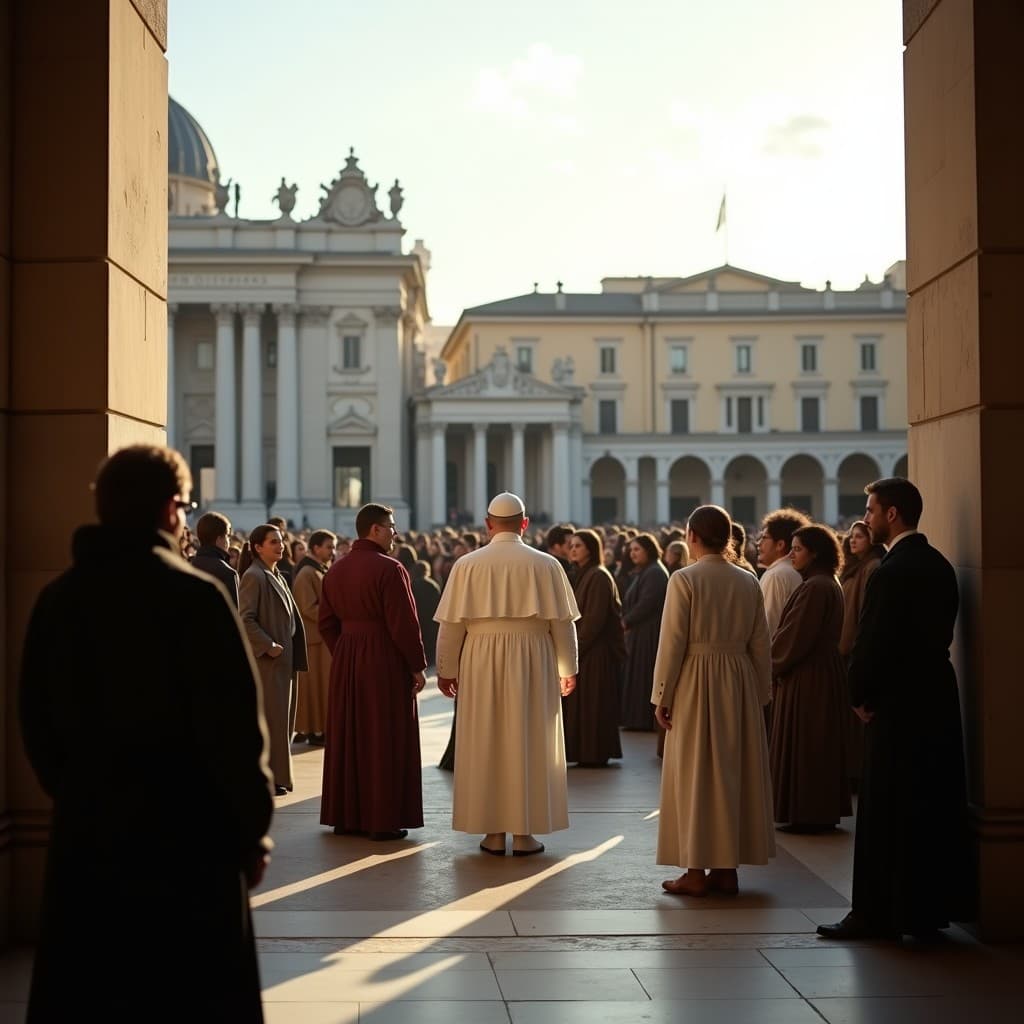
Pope Leo arrived in Spain on Saturday for a week-long visit centered on immigration and European identity, according to France 24. The pontiff will inaugurate a new tower at Barcelona's Sagrada Familia basilica and meet migrants who have crossed the Atlantic to reach Europe, signaling a shift in papal priorities toward direct engagement with the continent's migration crisis.
The visit represents the first time Pope Leo has traveled to an EU country outside Italy since his election, a choice that carries symbolic weight. Rather than visiting a major European capital for ceremonial reasons, the pontiff has chosen Spain—a nation with its own Mediterranean and Atlantic migration frontiers—to focus on a single, urgent issue: the human cost of irregular migration and Europe's response to it.
The New York Times reported that Pope Leo and Spanish Prime Minister Pedro Sánchez met on Monday, with both leaders having recently clashed with President Trump over migration policy and other issues. Yet their motivations differ: Sánchez's opposition to Trump reflects Spain's economic and geopolitical interests, while the pope's stance emerges from Catholic doctrine on human dignity and the Church's historical role as a refuge for the persecuted.
Pope Leo's visit to Spain marks a departure from the Vatican's traditional diplomatic rhythm. Papal journeys have historically served multiple purposes: reinforcing the Church's presence in Catholic nations, meeting with political leaders, and addressing local bishops and clergy. Yet this visit is narrowly focused on a single theme—migration—and on direct encounters with migrants themselves, not merely with government officials or ecclesiastical hierarchies.
France 24 reported that the pontiff will meet migrants who have braved dangerous Atlantic waters to reach Europe. This framing is significant: it positions the pope not as a distant moral authority pronouncing judgment from Rome, but as a witness to the lived reality of migration. The Vatican's media strategy has emphasized the pope's emotional engagement with migrants' stories, a departure from the more formal, doctrinal tone that characterized earlier papal statements on migration.
The choice of Spain as the destination for this visit also carries regional meaning. Spain faces migration pressures from both the Mediterranean and the Atlantic. The Canary Islands, off the coast of Morocco, have become a major entry point for migrants from West Africa. The Spanish government has struggled to manage arrivals while maintaining relations with Morocco and other transit countries. By visiting Spain, Pope Leo signals that the Vatican views migration not as an Italian problem or a Mediterranean problem, but as a European challenge requiring coordinated response.
The Washington Post reported that Pope Leo is drawing huge crowds in Madrid and seems to be making a star turn, enthralling the faithful with emotive assurance. This observation suggests that the pope's public persona has shifted from the more austere, intellectual style of his predecessors. Pope Leo, born in Chicago, brings a different sensibility to the role: more accessible, more focused on emotional connection, more willing to engage with contemporary social movements and popular culture.
The timing of the visit coincides with broader European debates about migration policy. The European Union has been tightening migration rules, according to reporting from earlier in June, and Italy has been bracing for new deportation burdens as a result. The pope's visit to Spain, with its emphasis on migrants' humanity and dignity, can be read as a counterweight to the EU's increasingly restrictive approach. The Vatican is not opposed to border control or national sovereignty, but it is insisting that migration policy must be grounded in recognition of migrants' fundamental humanity.
The New York Times noted that Pope Leo and Prime Minister Sánchez have both clashed with President Trump, but for different reasons. Sánchez opposes Trump's trade policies and his approach to NATO burden-sharing. Pope Leo's opposition to Trump appears to center on migration policy and the treatment of migrants at the U.S.-Mexico border. This convergence suggests that migration has become a central axis of conflict between the Vatican and the Trump administration, with Spain serving as a neutral ground for the pope to articulate an alternative vision.
For Italy and the Mediterranean region, the pope's focus on Spain carries implications. Italy has long borne the primary burden of Mediterranean migration, with the Italian coast guard and navy conducting thousands of rescues annually. Italian ports—Naples, Palermo, Messina—have become de facto processing centers for migrants arriving by sea. The Italian government has alternated between humanitarian rhetoric and restrictive policies, depending on which political coalition holds power.
By visiting Spain and engaging directly with Atlantic migrants, Pope Leo is implicitly acknowledging that migration is not primarily an Italian or Mediterranean phenomenon, but a European one. Migrants crossing the Atlantic to the Canary Islands are often fleeing the same conflicts and economic desperation that drive Mediterranean crossings. The pope's message—that Europe must respond to migration with compassion and coordination—applies equally to Spain, Italy, Greece, and other border states.
The Vatican's diplomatic posture under Pope Leo appears to be shifting toward greater visibility and direct engagement with contemporary crises. Rather than issuing encyclicals and statements from Rome, the pope is traveling to the sites of human suffering and speaking directly to those affected. This approach has roots in Catholic tradition—the preferential option for the poor, the emphasis on incarnational theology—but it represents a change in how the Vatican exercises soft power.
The Project Syndicate opinion piece on Pope Leo's first encyclical, Magnifica Humanitas, noted that the pope rejects the idea that markets alone can be trusted to shape society's technological future. The piece invokes the Tower of Babel as a metaphor for AI and its potential to either save or damn humanity. This theological framing suggests that Pope Leo is attempting to articulate a vision of human flourishing that transcends both market logic and technological determinism.
Migration fits within this broader papal vision. The pope appears to be arguing that migration policy, like AI policy, cannot be left to market forces or to the narrow interests of individual nation-states. Instead, it requires a framework grounded in human dignity, solidarity, and recognition of our common humanity. The visit to Spain is thus not merely a diplomatic gesture, but an attempt to model an alternative approach to migration—one based on encounter, compassion, and the acknowledgment that migrants are not merely policy problems to be managed, but human beings with stories, families, and rights.
For Marche and the Adriatic region, the pope's focus on migration has particular resonance. The Adriatic coast has become a secondary route for migrants attempting to reach Europe via the Balkans and the Alpine passes. The region's fishing communities have been drawn into rescue operations, with fishing vessels often the first responders when boats capsize or migrants are spotted in distress. The pope's emphasis on migrants' humanity and dignity resonates with the lived experience of Adriatic communities that have witnessed both the tragedy of migration and the resilience of migrants themselves.
The pope's visit to Spain also raises questions about the Vatican's role in European politics. The Church has traditionally maintained distance from partisan politics, but Pope Leo's explicit opposition to Trump and his focus on migration suggest a more engaged stance. This shift may reflect the pope's assessment that migration and technological change are defining issues of our time, requiring the Church to speak prophetically rather than remain neutral.
As Pope Leo concludes his week in Spain and prepares to return to Rome, his visit will likely be remembered as a turning point in his papacy. He has signaled that the Vatican intends to be a visible, vocal presence in European debates about migration, technology, and human dignity. Whether this approach will translate into concrete policy changes remains uncertain, but the symbolic weight of a pope traveling to Spain to meet migrants and speak about their dignity is undeniable. It suggests that the Vatican, under Pope Leo's leadership, is attempting to reclaim a prophetic role in European public life.