
FRIULI-VENEZIA GIULIA
Slovenia's rightward turn signals shift in Italy's Balkan calculus
Janez Jansa's return to power and pro-Israel stance alter the geopolitical balance on the EU's eastern edge.
Sergio Madrussan1,347 wordsEdition №7Sunday, 7 June 2026 — Edition № 7
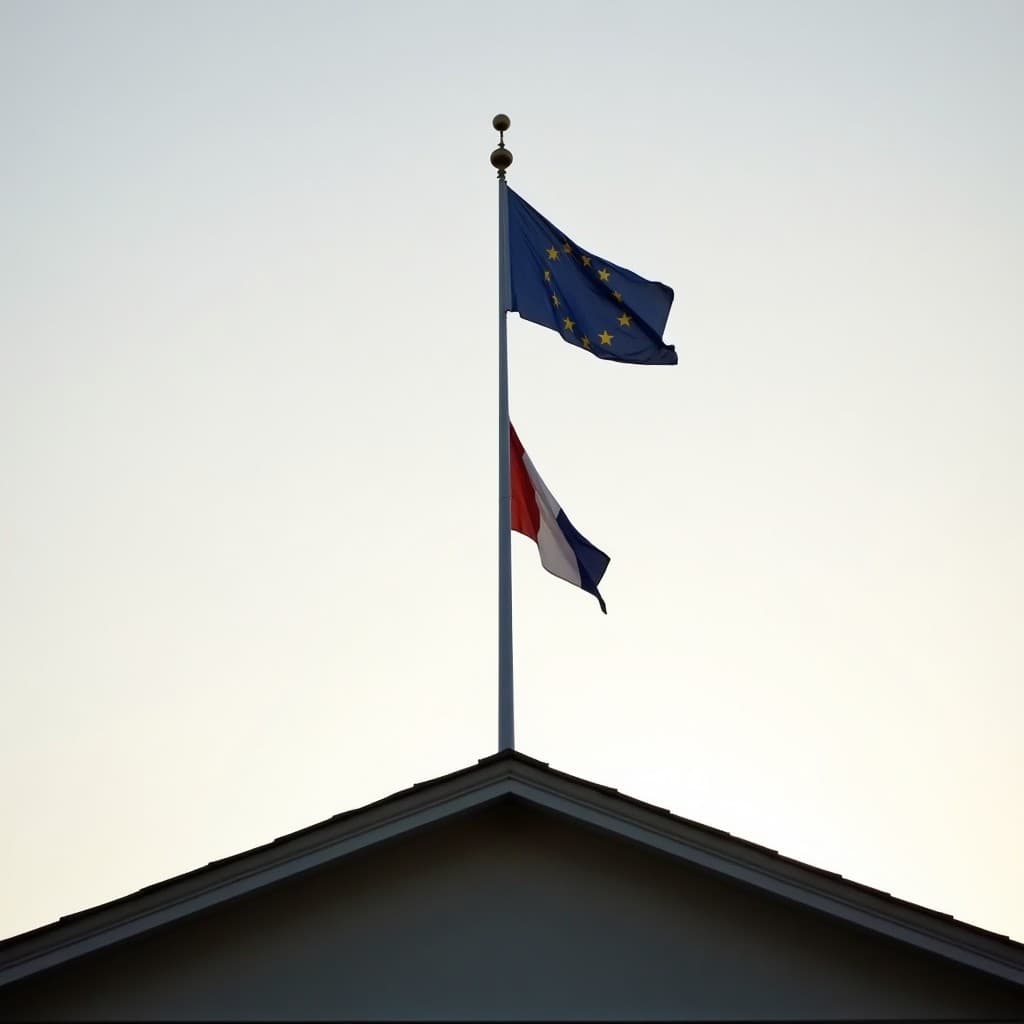
Less than an hour after Janez Jansa was sworn in as Slovenia's prime minister for the fourth time on June 5, he ordered the Palestinian flag lowered from the main government building in Ljubljana, where it had flown for two years. The move, reported by Bloomberg, marks a dramatic reversal of the outgoing government's foreign policy and signals a broader realignment in Central Europe's relationship with Israel and, by extension, the geopolitical weight of the EU's eastern frontier.
The symbolic gesture was followed by a more concrete disruption: Haaretz reported that on June 4, Slovenian authorities had prevented an Israeli carrier, Israir, from landing at Ljubljana airport, forcing the flight to divert to Croatia. The Israeli airline's CEO called the rejection a "blatant violation" of EU aviation agreements. Jansa's government has since moved to reverse such restrictions, signalling a return to what it frames as normal EU-Israel relations.
For Italy's Friuli-Venezia Giulia region, which shares a 232-kilometre border with Slovenia and serves as the gateway between the Mediterranean and Central Europe, the shift carries immediate strategic weight. Trieste's port, Italy's largest, depends on stable transit corridors through Slovenia and the Balkans. A Slovenian government aligned with Israel and the Western consensus on Ukraine—Jansa is a vocal NATO supporter—reshapes the calculus of trade, migration, and security that defines the region's role as a bridge between Italy and Central Europe.
Jansa's return to power, after two years of centre-left government under Robert Golob, represents the latest swing in Slovenian politics between pro-Western and more ambivalent stances toward the EU's institutional consensus. Bloomberg's reporting emphasizes the speed and symbolism of the flag removal—a deliberate statement of intent rather than a gradual policy shift. The move reflects Jansa's long-standing alignment with conservative European governments and his close relationship with Israeli leadership, a position that had been sidelined during Golob's tenure.
The aviation incident adds substance to the symbolic gesture. Haaretz's account of the Israir diversion suggests that the previous Slovenian government had used administrative measures to restrict Israeli carriers, a form of protest against Israeli policy in Gaza. Jansa's government has signalled it will dismantle such restrictions, aligning Slovenia with the broader EU position on aviation rights and, implicitly, on Israel's standing within the bloc.
The timing is significant. Slovenia's pivot occurs as the EU-Western Balkans summit convenes in Montenegro, with leaders from across the bloc gathering to discuss enlargement and security in the region. According to AP News, the summit is framed around countering "security and economic threats posed by Russia and China." Jansa's government, which has been notably hawkish on both fronts, will now represent Slovenia in those discussions with a clearer pro-Western, pro-NATO posture than its predecessor.
For Italy, the implications are layered. Trieste's role as a logistics hub depends on predictable, stable relations with Slovenia. The previous government's more ambivalent stance on Israel had not disrupted trade or transit, but it had created diplomatic friction that occasionally manifested in administrative delays or regulatory scrutiny. A Slovenian government aligned with Italy's own centre-right governments—and with the broader Western consensus—reduces such friction.
More broadly, Jansa's return signals a hardening of the EU's eastern frontier against Russian and Chinese influence. Slovenia, despite its small size, sits at a critical junction: it is both an EU member and a Balkan gateway. A government that is firmly aligned with NATO and Israel, and hostile to Russian interests, strengthens the Western position in a region where geopolitical competition has intensified since 2022. Italy, as a G7 member and a Mediterranean power with growing interests in the Balkans, benefits from a Slovenia that is unambiguously anchored to the Western bloc.
The Palestinian flag incident also reflects deeper currents in European politics. Over the past two years, several European governments have adopted symbolic gestures of solidarity with Palestinians, particularly after the October 2023 escalation in Gaza. Golob's government had been part of this trend. Jansa's removal of the flag is a counter-gesture, signalling that Slovenia under his leadership will not participate in what he and his allies view as anti-Israel activism within EU institutions. This aligns him with governments in Hungary, Poland, and parts of Italy that have resisted EU-level pressure to adopt more critical stances toward Israeli policy.
The regional press in Central Europe, according to foreign coverage, has noted Jansa's return as a significant shift in the Balkans' political centre of gravity. His government is expected to take a harder line on EU enlargement, pushing for faster integration of North Macedonia, Albania, and Serbia—but on condition that these countries align with NATO and Western security priorities. This contrasts with Golob's more gradualist approach and his willingness to engage with Russia on some issues, particularly energy.
For Trieste and the Friuli-Venezia Giulia region, the practical consequence is likely to be smoother coordination on border management, customs procedures, and port logistics. Jansa's government has historically been more aligned with Italian centre-right administrations on security and migration issues. The previous Slovenian government, while not hostile to Italy, had occasionally adopted positions on asylum and refugee policy that diverged from Italian preferences. A Jansa government is likely to be more aligned with Italy's approach to managing migration flows through the region.
The aviation dispute also hints at potential friction over EU rules and their application. Haaretz's reporting suggests that the previous Slovenian government had used regulatory discretion to restrict Israeli carriers, a form of political pressure that operates within the letter of EU law but tests its spirit. Jansa's government appears committed to a more legalistic, rule-based approach that would reduce such friction. This matters for Trieste's port and for the broader logistics sector, which depends on predictable regulatory environments across the region.
Looking ahead, Jansa's government will likely seek to strengthen ties with Italy, Hungary, and Poland—the EU's more conservative members—while maintaining formal compliance with Brussels. This could create new dynamics within the EU, particularly on issues like judicial independence, media freedom, and rule of law, where Jansa's government has a mixed record. But on geopolitical alignment and security matters, his return to power represents a consolidation of the Western position in Central Europe and the Balkans.
The Palestinian flag removal, while symbolic, also reflects a calculation about the EU's future direction. Jansa appears to be betting that the bloc's centre of gravity is moving toward a more explicitly pro-Israel, pro-NATO, and anti-Russian stance. By moving quickly on the flag, he signals that Slovenia under his leadership will not be an outlier or a voice for ambivalence. This positioning strengthens his hand in negotiations over EU enlargement and security policy, areas where Slovenia, despite its size, has outsized influence due to its geographic position.
For Italy's eastern frontier, the shift represents a return to the kind of alignment that characterized the region during the Cold War and the immediate post-Cold War period: a clear division between NATO members and non-members, with Slovenia firmly on the Western side. The previous Slovenian government had attempted to blur these lines somewhat, maintaining economic ties with Russia and adopting more neutral positions on Middle East conflicts. Jansa's government is reversing that experiment, betting instead on a clearer, more confrontational stance toward Russia and a more explicit alignment with Israel and the United States.