
BASILICATA
Basilicata's Oil Fields Face Global Energy Reckoning
As world markets tighten, Italy's largest onshore producer confronts the cost of transition in a region built on extraction
Pietro Lasorsa1,547 wordsEdition №10Wednesday, 10 June 2026 — Edition № 10
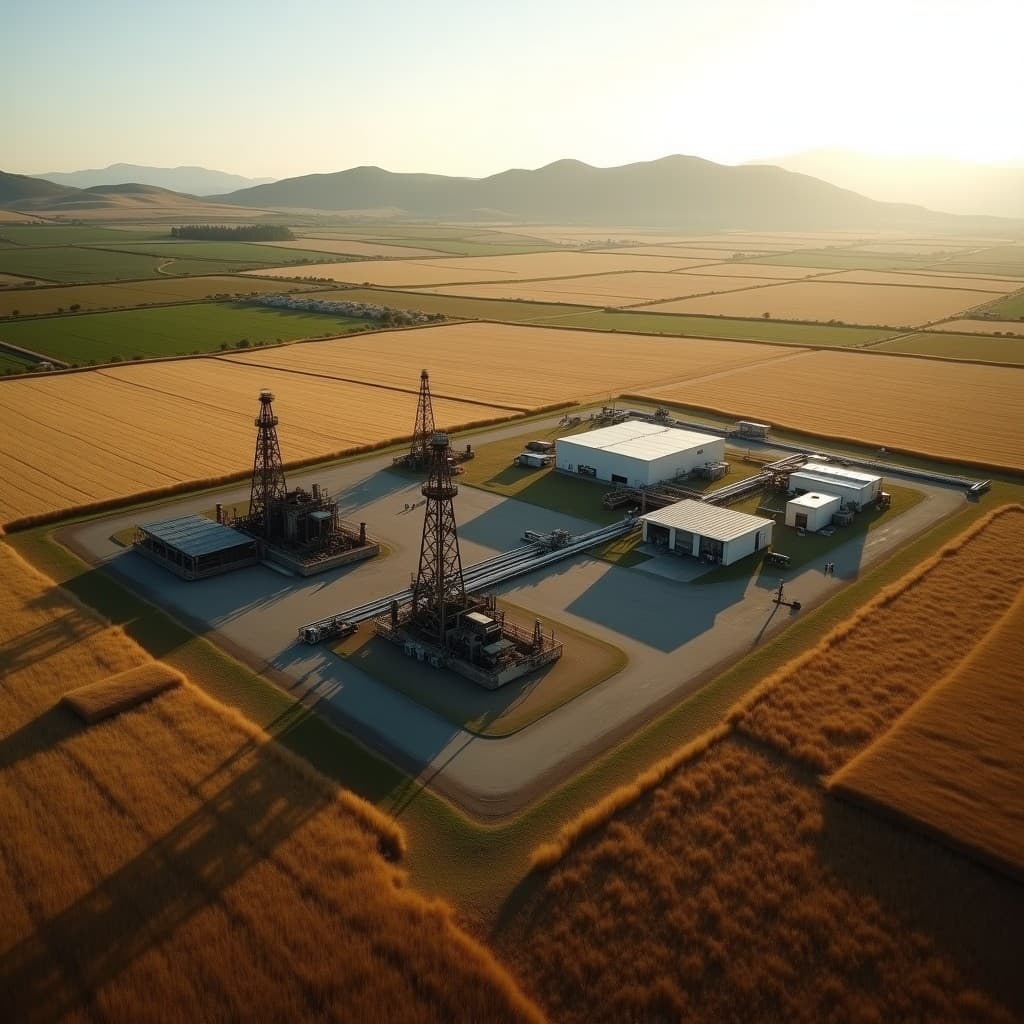
The world's oil markets are grinding tighter. According to Newsweek, the United States cannot rapidly replace the roughly 20 million barrels of oil disrupted around the Strait of Hormuz, and analysts say more domestic drilling is unlikely to deliver quick relief to consumers facing sharply higher petrol prices. Yet as global energy demand strains existing capacity, Basilicata—home to Italy's largest onshore oil field in the Val d'Agri—finds itself caught between two pressures: the world's continued hunger for crude and the mounting cost of the energy transition itself.
The Val d'Agri field, which has supplied roughly 80 per cent of Italy's domestic oil production, has long been the economic spine of the region. But the field is mature, and its reserves are finite. The global energy crisis of recent years has temporarily buoyed prices and extended the field's productive life, yet the underlying trajectory is clear: extraction cannot sustain Basilicata's economy indefinitely. The region must pivot, and that pivot is far more complex than simply switching off the wells.
Basilicata's dilemma mirrors a broader European paradox. While global energy markets remain volatile and supply-constrained, the European Union's climate commitments and the cost of energy transition are reshaping the continent's relationship with fossil fuels. For a region whose fiscal base, employment, and infrastructure have been built on oil revenue, the transition is not an abstract policy debate but a material crisis of livelihood and identity.
The Val d'Agri field began production in 1998 and has been the largest onshore oil operation in Italy ever since. For nearly three decades, it has generated tax revenue, employment, and investment in a region that, by most economic measures, sits at the southern edge of Europe's prosperity. Potenza, the regional capital, and the surrounding province have depended on the oil sector's stability. The field has also shaped Basilicata's relationship with the outside world: it is known abroad not primarily for its history, agriculture, or culture, but as an energy producer.
Yet the field's maturity is undeniable. Production has declined steadily over the past decade. The global energy crisis of 2022–2024 temporarily reversed that trend, as crude prices spiked and the geopolitical value of European oil rose sharply. But that reprieve was temporary. As Newsweek reported this week, even as global markets remain tight and petrol prices remain elevated, the structural problem persists: major producers cannot quickly scale up output to replace disrupted supply. For Basilicata, the implication is stark: the window in which the Val d'Agri can generate significant new revenue is closing.
The regional government has long understood this. Basilicata's development strategy, articulated through EU cohesion funding and regional planning documents, has nominally pivoted toward diversification: renewable energy, agriculture, tourism, and small-scale manufacturing. Yet these sectors remain underdeveloped relative to the oil economy's scale. Renewable energy capacity in the region is growing, but slowly. Agriculture—wheat, vegetables, and some wine—remains subsistence-level for many producers. Tourism, centred on Matera's UNESCO heritage status and film-tourism boom, is concentrated geographically and seasonally.
The energy transition itself carries a hidden cost for Basilicata. The region must invest in grid modernisation, renewable infrastructure, and workforce retraining—all expensive, all necessary, none of them generating the immediate fiscal returns that oil extraction has provided. The European Union's cohesion funds and recovery financing can help, but they are finite and competitive. Basilicata competes with other southern regions—Calabria, Sicily, Campania—for the same pool of transition funding.
The global energy market tightness that Newsweek documented this week actually complicates Basilicata's transition. Higher oil prices extend the economic life of mature fields and create political pressure to continue extraction. Operators and local governments face a perverse incentive: keep the wells open as long as prices are high, delaying the painful shift to a post-oil economy. That logic has held in Basilicata for years. But it also deepens the region's structural dependence on a declining resource and postpones the harder work of building alternative economic bases.
The regional consequence is demographic. Basilicata's population has fallen from 610,000 in 1991 to roughly 537,000 today—a loss of nearly 12 per cent over three decades. The young, especially those with education and skills, have emigrated to the North or abroad. The oil sector, despite its decline, has retained some skilled workers and some investment. A post-oil Basilicata risks accelerating that exodus if alternative employment is not created at scale.
Matera's cultural renaissance—its designation as European Capital of Culture in 2019, its role as a film location, its UNESCO World Heritage status—has brought tourism and some new investment. But Matera is a city of 60,000 in a region of 537,000. The benefits of tourism have not spread uniformly across the province or into the interior. The Val d'Agri field sits in the interior, in municipalities like Viggiano and Grumento Nova, where tourism has barely penetrated and where oil employment remains the primary source of formal work.
The European Union's energy transition framework, embodied in the Green Deal and the Fit for 55 package, sets binding targets for emissions reductions and renewable energy deployment. Italy, as an EU member, must meet these targets. Basilicata, as part of Italy, must contribute. But the burden falls unevenly: regions dependent on fossil fuels bear the transition cost more acutely than regions that have already diversified. The EU's Just Transition Mechanism is meant to cushion this blow, but its funding is limited and its distribution contested.
Basilicata's regional government has applied for Just Transition funding and has begun planning a managed decline of the oil sector. But planning and execution are different. The oil companies operating the Val d'Agri field—primarily Eni, the Italian state-controlled energy giant—have their own timelines and financial imperatives. They will extract as long as extraction is profitable. When it ceases to be profitable, they will leave. The region will inherit the infrastructure, the environmental liabilities, and the economic void.
The environmental cost of oil extraction in Basilicata has long been contested. The Val d'Agri field sits in a region of significant agricultural land and natural beauty. Extraction has required pipelines, processing facilities, and infrastructure that have altered the landscape. Environmental groups have documented concerns about water quality, air pollution, and the cumulative impact of industrial activity on a rural region. The transition away from oil offers an opportunity to remediate some of this damage, but remediation is expensive and slow.
Basilicata's energy transition is not merely a regional problem. It is a microcosm of Italy's broader energy challenge. Italy imports roughly 85 per cent of its energy and has long sought to develop domestic renewable capacity to reduce dependence on foreign gas and oil. The Val d'Agri field has been part of that strategy—a source of domestic crude that reduces import dependence. But as the field declines and the EU's climate commitments tighten, Italy must accelerate renewable deployment and energy efficiency. Basilicata, as the country's largest onshore oil producer, must lead that transition.
The global energy market dynamics that Newsweek documented—tight supply, high prices, limited room for rapid scaling—create a window of opportunity for Basilicata. High oil prices mean higher tax revenue in the near term. That revenue can be invested in transition infrastructure: solar and wind capacity, grid modernisation, workforce retraining, and economic diversification. But the window is narrow. In five to ten years, as global renewable capacity expands and electric vehicle adoption accelerates, oil demand will decline further. Basilicata must act now.
The regional government's strategy, as articulated in planning documents and EU funding applications, emphasises renewable energy, particularly solar and wind. Basilicata has significant solar potential, especially in the southern lowlands. Wind resources are present but more variable. Agricultural land could host agrivoltaic systems—solar panels integrated with farming—that generate both energy and food. But these transitions require capital, technical expertise, and time. They also require political will to resist the short-term pressure to keep oil extraction going.
The human dimension is perhaps the most difficult. Oil workers in the Val d'Agri—engineers, technicians, labourers—have built careers and lives around extraction. Retraining programmes can help, but they cannot fully replace the wages, stability, and identity that oil employment has provided. The region's younger population has already begun leaving; the transition will accelerate that exodus unless alternative employment is created at scale. That requires not just renewable energy infrastructure but new industries: advanced manufacturing, digital services, agribusiness, tourism.
Basilicata's transition is not unique. Similar dynamics are playing out in other oil-dependent regions across Europe and the world. But Basilicata's scale, its dependence on a single resource, and its position in a region already marked by economic disparity make the stakes particularly high. The region's future—whether it becomes a model for managed energy transition or a cautionary tale of economic collapse—will be watched by policymakers across southern Europe.