
CULTURA
Venice Biennale's Jury-Free Model Sparks Artist Revolt
Over 100 participants threaten legal action over visitor-voted awards, exposing tensions in the world's premier contemporary art show.
Eleonora Vanzetti1,247 wordsEdition №9Tuesday, 9 June 2026 — Edition № 9
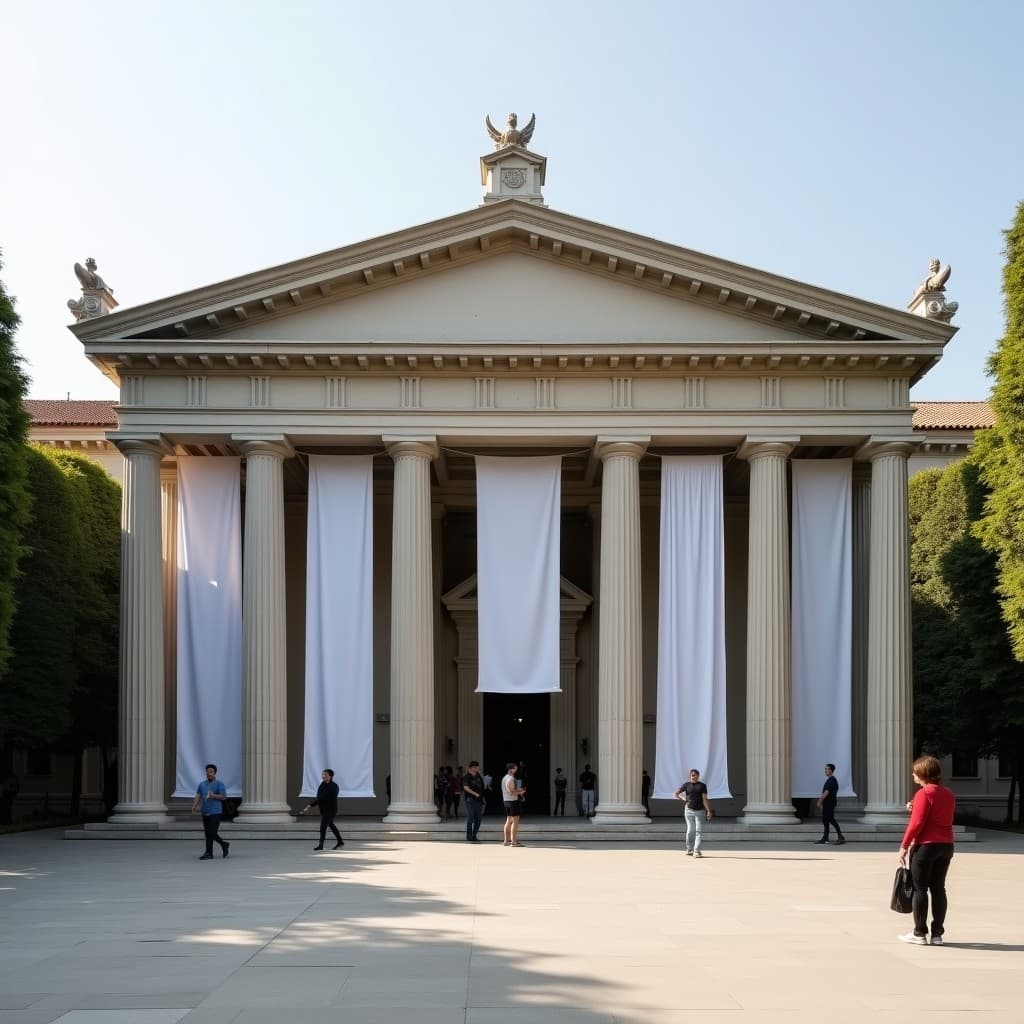
More than 100 artists participating in the 2026 Venice Biennale have threatened legal action against the institution over its decision to award prizes through visitor voting rather than a traditional jury of experts. According to The Art Newspaper and AP News, participants from the Biennale's In Minor Keys exhibition and various national pavilions issued a statement on June 3 demanding their removal from the ballot, citing repeated requests that organisers had ignored.
The Biennale, which opened this month, dispensed with the Golden Lions—its most prestigious awards—in favour of allowing visitors to vote for the best national pavilion and overall participants. The move has transformed what was once a carefully curated competition into what foreign correspondents describe as the institution's most chaotic and contested edition in recent memory.
The dispute cuts to a deeper question about the Biennale's founding mission. According to STIRworld, the institution was styled in 1931 under Benito Mussolini as "the Geneva of the arts"—a stage for neutral international cultural exchange. That rhetoric of neutrality has persisted for nearly a century, allowing the Biennale to host participants from nations in conflict without appearing to take sides. The jury-free voting model, organisers appear to have reasoned, would extend that neutrality further by removing expert judgment from the equation.
Yet the 2026 edition has shattered that illusion. The absence of a jury has coincided with heightened geopolitical tensions at the Biennale itself. Newser reported that Pussy Riot and FEMEN activists protested Russia's presence at the event following its absence after the 2022 invasion of Ukraine. The Russian pavilion became a focal point for political contestation—precisely the kind of charged moment that a jury might have navigated with institutional authority, but which a public vote cannot resolve.
The artists' legal threat represents a fundamental challenge to the Biennale's governance model. According to AP News, the participating artists argue that the voting system strips them of agency and exposes their work to popularity contests rather than aesthetic evaluation. The statement, posted on the art platform e-flux, framed the dispute as a failure of institutional responsibility: organisers had received repeated requests to remove artists from the ballot but had not acted.
For Venice and the Veneto region, the Biennale's reputation carries outsized weight. The contemporary art show draws international collectors, curators, critics and tourists to the lagoon city each year, generating significant cultural capital and tourism revenue. A contested, legally embattled edition risks damaging that prestige at a moment when Venice is already struggling with mass tourism and housing affordability. The Art Newspaper's June coverage of the Biennale had focused on positive developments—including a monumental intervention by French street artist JR wrapping a structure from June 6 to 28—but the legal dispute has overshadowed those narratives in the international press.
The tension between neutrality and accountability is not new to the Biennale. STIRworld quoted Clarissa Ricci, a specialist in the institution's history, observing that "the Biennale has kept the rhetoric of neutrality because it's really handy—you can have anybody take part and say it's not a problem." That handy neutrality has allowed the Biennale to present itself as apolitical even as it hosted exhibitions during the Cold War, the Yugoslav wars, and now the Ukraine conflict. But the jury-free voting model appears to have exposed the limits of that pose.
The artists' legal action could force the Biennale to reconsider its awards structure before the 2028 edition. If the courts rule in the artists' favour, organisers may face pressure to restore a jury system or to create opt-in mechanisms allowing participants to decline inclusion in public voting. Either outcome would represent a significant retreat from the 2026 experiment.
The dispute also reflects broader questions about expertise and democratic participation in cultural institutions. By moving to visitor voting, the Biennale appeared to democratise the award process—allowing the public rather than a small circle of curators to decide which artists and nations deserved recognition. Yet the artists' response suggests that democratisation without consent is experienced as disempowerment. The public vote, in their view, substitutes popularity for aesthetic judgment and exposes their work to forces beyond their control.
Foreign coverage has framed the legal threat as a symptom of the Biennale's institutional crisis. The Art Newspaper reported that organisers had received the artists' demands weeks before the June 3 statement but had not responded. That silence appears to have hardened the artists' resolve to pursue legal remedies. The Biennale's silence also suggests internal disagreement about how to proceed—whether to defend the voting model as a democratic innovation or to retreat to a more traditional jury structure.
The timing of the dispute is significant. The Biennale opened in June 2026 at a moment of heightened geopolitical fragmentation. The presence of Russian artists, the activism around the Russian pavilion, and the artists' legal threat all point to an institution struggling to maintain its neutrality in an era when neutrality itself is contested. The Biennale's founding mission—to serve as a Geneva of the arts—assumes a stable international order in which nations can coexist peacefully on a cultural stage. That assumption no longer holds.
For the international art world, the Venice Biennale remains the most prestigious contemporary art show. Its biennial cycle shapes the global art calendar, and its awards carry weight in the market and in museum acquisitions. A damaged Biennale diminishes the prestige of participating artists and nations alike. The legal dispute therefore carries consequences far beyond Venice itself, signalling to the international art community that the institution's governance is unstable.
The outcome of the artists' legal action remains uncertain. Italian courts will need to determine whether the Biennale's voting system violates the rights of participating artists or whether organisers have the institutional prerogative to set their own award criteria. But regardless of the legal result, the 2026 Biennale has already become a case study in the tensions between democratic participation and expert curation, between neutrality and political reality, and between an institution's founding mission and its contemporary practice.