
CAMPANIA
Vesuvius preserved a brain in glass; Herculaneum yields new secrets
Scientists study vitrified tissue from young male buried nearly 2,000 years ago; Campania's volcanic legacy reshapes understanding of Roman death
Rosaria Esposito1,389 wordsEdition №8Monday, 8 June 2026 — Edition № 8
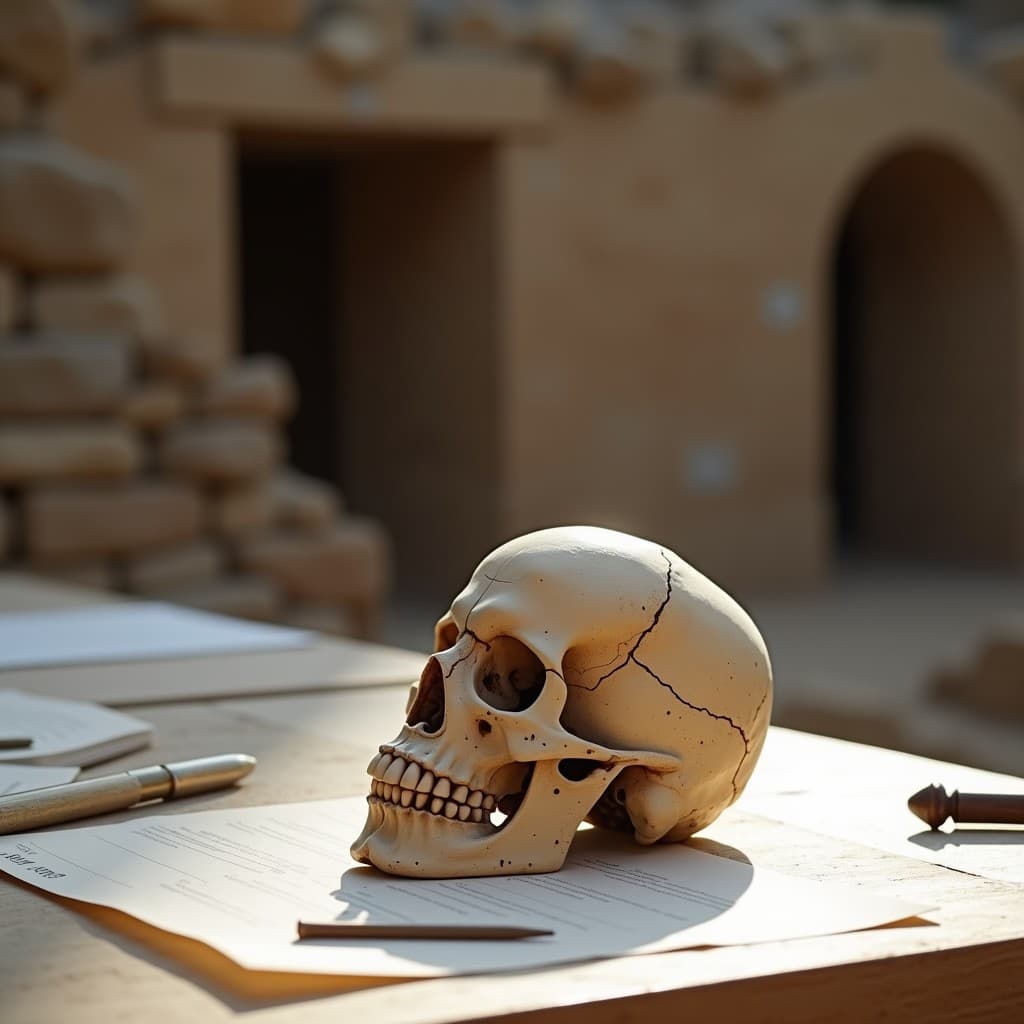
Scientists are studying a black glass-like mass found inside a skull discovered at Herculaneum, according to reporting from the Times of India. The remains belong to a young male whose body was unearthed from the Collegium Augustalium structure in the Roman city, which suffered destruction similar to neighbouring Pompeii during the eruption of Mount Vesuvius approximately 2,000 years ago. Researchers argue that the eruption may not have entirely destroyed the victim's brain tissue, but rather transformed it into a vitrified, glass-like substance through extreme heat.
The discovery represents a rare window into the mechanics of Vesuvius's killing force. The Times of India reported that the black mass inside the skull may constitute preserved brain tissue, a finding that would be extraordinary. If confirmed, it would provide direct physical evidence of how the volcano's extreme temperatures affected human bodies in the moments of death.
For Campania, the discovery underscores the region's unique position as a living archive of Roman catastrophe. Herculaneum and Pompeii remain among the world's most significant archaeological sites precisely because Vesuvius's eruption preserved them in a state of sudden suspension. Every new finding from these sites adds texture to understanding not only Roman life but Roman death.
The remains were excavated from the Collegium Augustalium, a structure in Herculaneum that housed members of a Roman religious college. The building, like much of Herculaneum, was buried under metres of volcanic material when Vesuvius erupted in 79 AD. The young male's body was preserved in the ash and pumice, his skeleton intact enough to permit detailed examination nearly two thousand years later.
The black glass-like substance found within the skull is the focus of intense scientific scrutiny. The Times of India reported that researchers believe this may represent vitrified brain tissue—brain matter transformed into a glass-like state by the extreme heat of the eruption. If confirmed through further analysis, this would be the first direct evidence of brain tissue preservation from Vesuvius's victims, offering unprecedented data about the temperatures and conditions at the moment of death.
Vitrification occurs when organic material is exposed to extreme heat and then cools rapidly. The process essentially converts the material into a glass-like substance, preserving its structure in a fundamentally altered state. For brain tissue to vitrify, temperatures would need to reach several hundred degrees Celsius. The fact that such conditions may have existed inside a human skull during the eruption speaks to the ferocity of Vesuvius's pyroclastic flows—superheated clouds of gas and ash that moved at tremendous speed down the volcano's slopes.
Previous discoveries at Herculaneum have hinted at such extreme conditions. Foreign archaeological coverage has documented cases where wooden beams were charred but not consumed, and where the heat was sufficient to cause bodies to contract in characteristic postures. The Times of India's reporting on the vitrified brain tissue represents a more direct and intimate measure of that heat.
The discovery also illuminates the process of death itself. Victims of Vesuvius's eruption did not die slowly or uniformly. Some were killed by the heat of pyroclastic flows; others by asphyxiation from ash and toxic gases; still others by the collapse of buildings. The vitrified brain tissue suggests that at least some victims were exposed to temperatures capable of transforming organic matter into glass, a death so sudden and extreme that their bodies were essentially flash-cooked.
For Campania's scientific community and cultural institutions, the discovery reinforces the region's role as a centre of volcanological and archaeological research. The National Museum of Naples, which houses much of the material from Pompeii and Herculaneum, is one of Europe's premier repositories of Roman artefacts. New findings from the sites feed into ongoing research programs that draw scholars from across the world.
The discovery also has implications for understanding Herculaneum's preservation. Unlike Pompeii, which was buried under metres of pumice and ash, Herculaneum was buried under a different type of volcanic material—a mixture of ash, pumice, and mud flows that created a more airtight seal. This difference in burial conditions may explain why Herculaneum's organic materials, including wood and food, are often better preserved than at Pompeii. The vitrified brain tissue is consistent with this pattern of exceptional preservation.
The Times of India's reporting notes that the discovery challenges some assumptions about what survives volcanic burial. Soft tissues—brain matter, organs, skin—are typically destroyed by time and microbial action. Yet Vesuvius's extreme heat and the subsequent anaerobic conditions created by the ash seal may have prevented decomposition and allowed vitrification. This suggests that other soft-tissue remains may be present at Herculaneum, awaiting discovery and analysis.
The broader scientific context is one of advancing analytical techniques. Modern imaging technology—CT scans, electron microscopy, chemical analysis—allows researchers to examine ancient remains in ways that were impossible even a decade ago. The vitrified brain tissue can be analysed without destructive excavation, revealing its composition and structure. This non-invasive approach has become standard in archaeological research at the Campanian sites.
The discovery also feeds into ongoing debates about Vesuvius's future. The volcano remains active, and Campania's population—concentrated in Naples and surrounding towns—lives in the shadow of a geological threat that has not erupted since 1944. Understanding how Vesuvius killed in 79 AD informs modern hazard assessment and evacuation planning. The Times of India's reporting on the vitrified brain tissue, while focused on ancient history, has implications for contemporary risk management.
For Campania's tourism industry, discoveries like this reinforce the region's appeal as a destination for cultural and educational tourism. Herculaneum and Pompeii draw hundreds of thousands of visitors annually, many of them motivated by the sites' unique status as preserved Roman cities. New discoveries generate media attention and academic interest, sustaining the sites' prominence in global consciousness and their value as tourist attractions.
The discovery also illustrates the ongoing work of excavation at Herculaneum. Unlike Pompeii, which was largely excavated in the 18th and 19th centuries, Herculaneum still contains unexcavated areas. The Collegium Augustalium, where the young male's remains were found, has been the subject of systematic excavation in recent years. Each season yields new artefacts and new insights into Roman life and death.
Looking forward, the vitrified brain tissue will likely become a focus of intensive study. Researchers will seek to confirm its composition, understand the conditions that produced it, and extract any information it may contain about the victim's health, diet, or cause of death. If the tissue can be chemically analysed, it may reveal details about the eruption's temperature profile and the sequence of events that killed the inhabitants of Herculaneum.
The discovery is also a reminder of Vesuvius's role in shaping Campania's identity. The volcano is not merely a geological feature; it is a cultural presence, a source of both fear and fascination. The preservation of Herculaneum and Pompeii has made the region synonymous with Roman archaeology and with the dramatic intersection of human civilisation and natural catastrophe. Each new finding from these sites adds another layer to that narrative.