
CAMPANIA
Scientists find vitrified brain tissue in Herculaneum skull
Discovery at 2,000-year-old Roman site challenges assumptions about Vesuvius's destructive power
Rosaria Esposito1,247 wordsEdition №5Friday, 5 June 2026 — Edition № 5
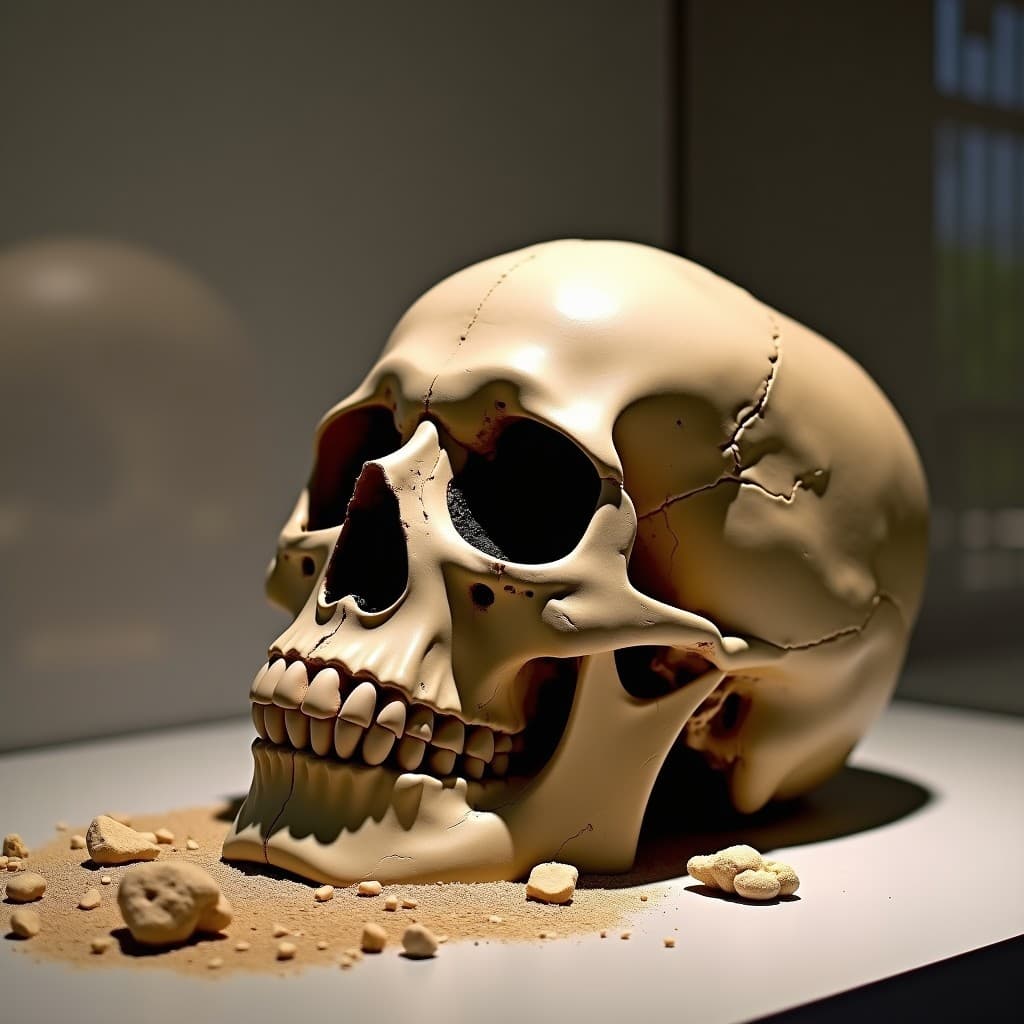
A black glass-like mass discovered inside the skull of a young male skeleton from Herculaneum has prompted scientists to reconsider what happens to human tissue during extreme volcanic heat. The Times of India reported this week that researchers believe the material may be vitrified brain tissue—organic matter transformed by intense temperature into a glass-like state—rather than destroyed entirely as conventional understanding of Vesuvius's eruption had suggested.
The remains were unearthed from the Collegium Augustalium, a Roman structure in Herculaneum that, like its neighbour Pompeii, was buried when Mount Vesuvius erupted roughly two millennia ago. The discovery challenges long-held assumptions about the eruption's capacity to annihilate the human body at the molecular level.
For Campania, where Vesuvius looms over the Naples metropolitan area and where Herculaneum and Pompeii draw hundreds of thousands of international visitors annually, the finding adds a new dimension to how the world understands the region's most famous catastrophe. The volcano remains active, and its history continues to shape how foreign media frame both the region's peril and its archaeological significance.
The research, as reported by the Times of India, centres on material preserved in conditions that allowed for an unusual form of preservation. When volcanic material reaches temperatures exceeding 300 degrees Celsius, organic compounds can undergo vitrification—a process more commonly associated with glass-making than with human remains. The black mass inside the skull suggests that at least some of the victim's neural tissue may have been transformed rather than completely destroyed by the heat.
Herculaneum, buried under volcanic pumice and ash in 79 AD, has long offered archaeologists a more detailed window into Roman life than Pompeii. The site's anaerobic conditions—sealed from oxygen by layers of volcanic material—have preserved organic matter with unusual fidelity: wood, food, textiles, and in some cases, the outlines of bodies themselves. The young male whose skull now contains this glass-like deposit represents a new category of evidence about how the eruption affected human remains.
The implications extend beyond academic curiosity. If soft tissue can be preserved through vitrification, it opens new avenues for understanding not only what happened to the people of Herculaneum but also what information their remains might still contain. Researchers may be able to extract genetic material, isotopic signatures, or other biochemical data from tissue previously thought to be irretrievably lost.
For Campania, the discovery arrives as the region continues to market itself internationally as a destination shaped by volcanic history. Naples sits in the shadow of Vesuvius; the volcano's 1631 eruption killed an estimated 4,000 people and remains one of Europe's deadliest natural disasters. Today, roughly three million people live within the volcano's potential impact zone, making it one of the world's most densely populated areas adjacent to an active volcano.
The foreign press has long framed Vesuvius as both a threat and a tourist asset. The volcano's eruption preserved Pompeii and Herculaneum in a way that has made them invaluable archaeological sites, drawing visitors from around the world. This latest research, reported internationally, reinforces that narrative: the catastrophe that killed thousands also created a natural archive of Roman life.
International science coverage has increasingly focused on Vesuvius's ongoing activity. The volcano last erupted in 1944, during World War II, and seismic monitoring suggests it remains restless. Foreign outlets covering Italian geology and volcanology regularly note that an eruption on the scale of 79 AD would be catastrophic for the modern Naples region, displacing millions and causing economic damage on a scale difficult to calculate.
The Herculaneum discovery also reflects broader trends in how archaeology and science are reported internationally. Foreign media outlets emphasize the technological sophistication of modern analysis—isotope dating, DNA extraction, chemical imaging—applied to ancient remains. The vitrified brain tissue, if confirmed, would represent a convergence of volcanic science, human biology, and archaeological method.
For the Campania bureau, the story illustrates how the region's most famous historical event continues to generate international scientific interest and media coverage. Pompeii and Herculaneum are not merely tourist destinations or cultural heritage sites in foreign coverage; they are living laboratories where new questions about human survival, preservation, and the power of natural forces continue to be asked.
The research also underscores a tension in how Campania is presented to the world. On one hand, the region is marketed as a place of beauty, culture, and culinary tradition—Naples as a vibrant, living city. On the other, it is framed through the lens of catastrophe: a region defined by its proximity to danger, its archaeological treasures born from disaster, its vulnerability to forces beyond human control. This discovery, presented through international science outlets, reinforces both narratives simultaneously.
The Times of India's reporting did not specify when the research findings will be formally published in a peer-reviewed journal, nor did it name the specific research team involved. International science coverage of Herculaneum and Pompeii typically involves Italian institutions working with foreign universities and research centres, though the attribution in this case remains to the Indian outlet's reporting.
For visitors to Herculaneum—and the site receives roughly 250,000 international visitors annually according to foreign travel coverage—the discovery may add another layer of meaning to the experience. The young man whose skull contains this preserved tissue becomes not an abstraction but a specific individual whose body was transformed by heat and time in ways that modern science is only now beginning to understand.
The finding also connects to broader international conversations about how we preserve and interpret human remains. Foreign media coverage of archaeology increasingly grapples with ethical questions about displaying and studying the dead, particularly in contexts where the remains belong to people who lived centuries or millennia ago. The Herculaneum discovery, presented as a scientific breakthrough, also implicitly raises questions about what we do with these remains and what we owe to the people they represent.